





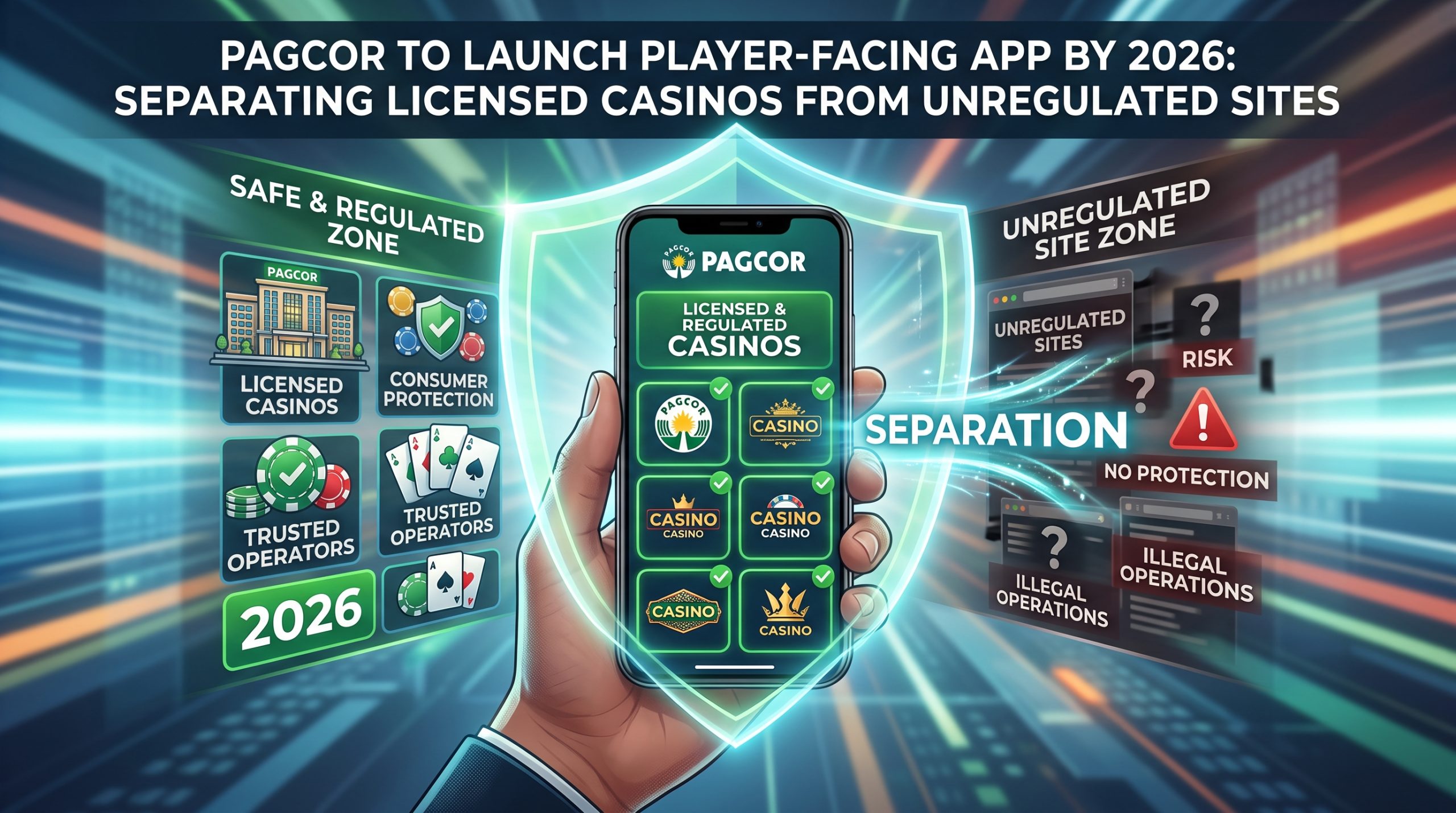
The Philippine Amusement and Gaming Corporation (Pagcor) is building a mobile application designed to let players tell licensed online casinos apart from unregulated ones. Chairman and chief executive Alejandro H Tengco disclosed the plan on Monday during a House budget hearing, setting a launch window before the end of 2026. The tool extends Pagcor Guarantee, the verification system the regulator rolled out in June 2025, and arrives as roughly half of all gaming sites accessed in the country operate without a licence.
That figure alone tells you why the regulator is moving.
What the App Means for Operators and Players
Before the detail, the short version: this is a consumer-protection instrument with a regulatory enforcement edge. It pushes players toward licensed platforms while giving Pagcor a cleaner line of sight into who sits outside the perimeter.
- Verification becomes portable. Players will be able to check a site’s licensing status on their phones before they deposit a peso, lowering the friction that has historically kept casual users inside unregulated channels.
- Licensed operators gain a visibility advantage, since inclusion in an official app functions as a trust signal that unlicensed rivals cannot replicate.
- Dispute resolution goes in-app. The platform will host a formal mechanism for players to raise complaints against licensed operators, a compliance layer that arguably raises the bar for service standards across the sector.
- Payment channels are now a target. By working to disrupt the financial rails behind unauthorised sites, Pagcor is attacking the money, not just the message.
- The 2026 timeline gives operators a runway to align, but it also signals that the informal grey zone is narrowing.
Half the Market Sits Outside the Perimeter
Tengco put the scale of the problem plainly: around 50% of online gaming sites accessed in the Philippines currently run without proper licensing. That is not a fringe issue. It is a structural one.
“Keeping players within the regulated sector has been an ongoing challenge for Pagcor and our law enforcement partners,” he said. His pitch to consumers was equally direct: “The easier it is for them to identify where they can legally play, the better we can protect them from illegal operators and the risks that come with unregulated gaming.”
The logic behind Pagcor Guarantee carries into the new app. When it launched in mid-2025, the system let players confirm whether a site was duly licensed before wagering or transferring funds. The forthcoming application repackages that capability for mobile and adds enforcement muscle. Whether an app alone can pull half a market back across the line is the question no one has answered yet.
A Multi-Agency Push Against Unlicensed Platforms
Pagcor is not doing this in isolation. The regulator is coordinating with the Department of Information and Communications Technology (DICT), the National Telecommunications Commission (NTC) and the Cybercrime Investigation and Coordination Center (CICC).
The joint effort has two fronts. One identifies unlicensed operators. The other goes after the payment infrastructure those operators depend on, particularly the channels routing player deposits into unauthorised platforms. Cutting off the money is harder to circumvent than blocking a URL, and it reflects a shift in how regulators across the region are thinking about enforcement. Choke the cash, and the site follows.
Details on the technical mechanics of the app, and how it will interface with telecom-level blocking, have not been published by the regulator.
The Fee Regime Behind the Strategy
The app is one piece of a broader agenda Tengco outlined earlier this year, when he told the Philippine gaming regulator’s official channels his priorities for the coming 25 months. Chief among them: legislative approval for a comprehensive online gambling law. A revised operator fee structure took effect in June 2025 and now anchors the commercial framework.
| Operator type | Minimum guaranteed fee (monthly) | Revenue basis |
|---|---|---|
| With online casino games | PHP9 million | PHP30 million at 30% tax rate |
| Without online casino games (e.g. sports betting sites) | PHP3 million | PHP15 million |
The revenue picture complicates the timing. In the second quarter of 2025, Pagcor reported PHP88.13 billion in gross gaming revenue, a 20.33% drop against the same period a year earlier. A regulator tightening the screws on unlicensed play while its own top line contracts is walking a narrow beam: too much friction risks pushing revenue further down, too little leaves the grey market intact.
Why the Timing Matters for the Sector
The precedent here is worth watching. A state-backed app that steers consumers toward licensed operators gives the regulator a template it can refine and expand, and it hands compliant businesses a defensible market position they can point to. For unlicensed operators, the calculus changes the moment payment channels come under sustained pressure.
Still, execution is everything. An app is only as effective as its adoption, and convincing players who already gamble on unregulated sites to consult an official tool first is a behavioural challenge, not a technical one. Pagcor is betting that convenience does the persuading.
Frequently Asked Questions
When will the Pagcor app be available?
Pagcor expects to launch the application before the end of 2026. It builds on the Pagcor Guarantee verification system introduced in June 2025.
What will the app actually do?
It has two core functions: verifying whether an online gaming site is licensed, and giving players a formal way to resolve disputes with licensed operators. Both aim to keep users inside the regulated sector.
How big is the unlicensed gambling problem in the Philippines?
According to Tengco, roughly 50% of online gaming sites accessed in the country operate without proper licensing.
Which agencies are involved?
Pagcor is working with the DICT, the NTC and the CICC to identify unlicensed operators and disrupt the payment channels that support them.
Does this affect operator fees?
Not directly, though it sits within the same regulatory push. Since June 2025, casino operators face a minimum guaranteed fee of PHP9 million monthly, while non-casino operators such as sports betting sites pay PHP3 million.


