





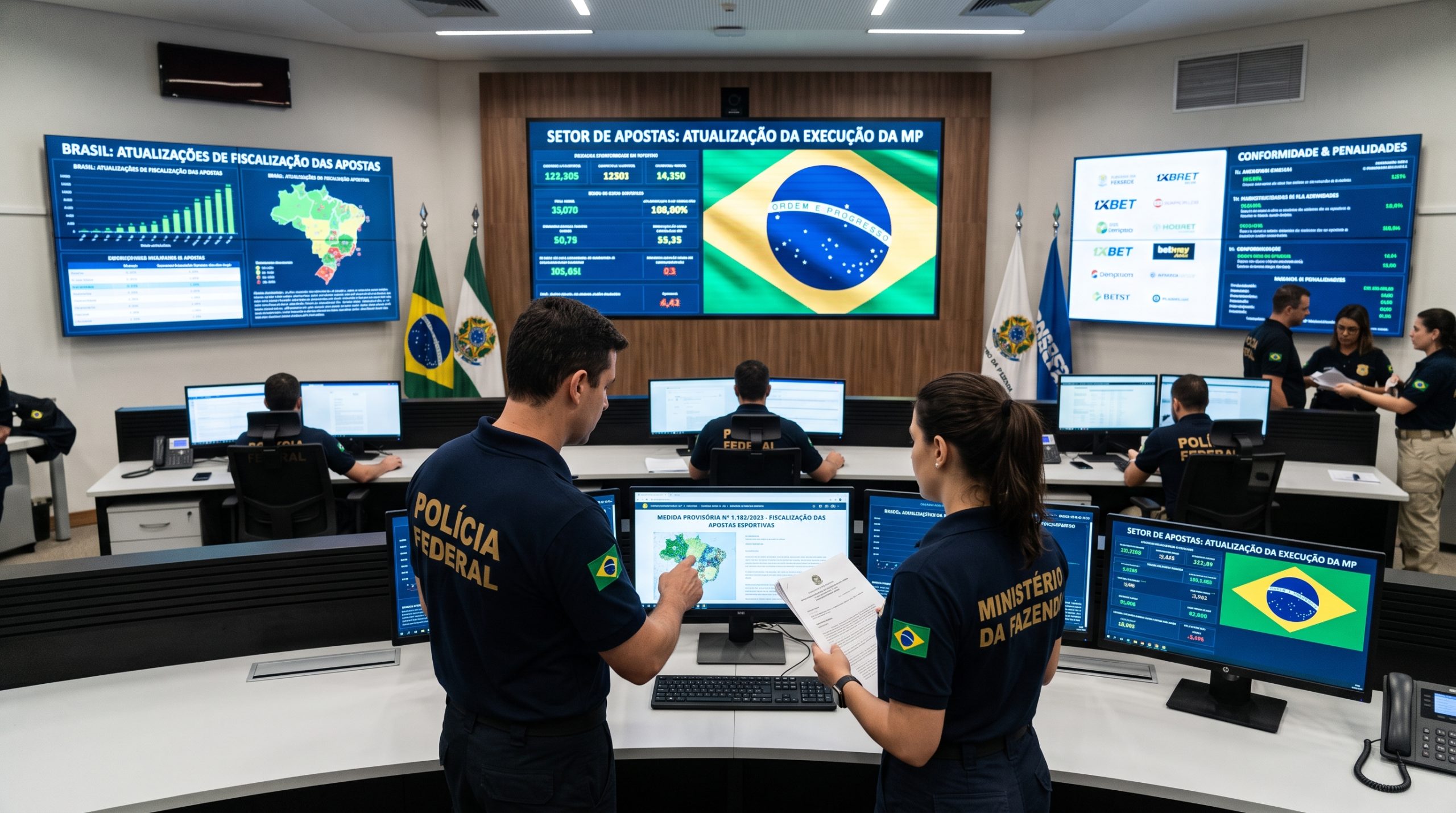
The Brazilian government has issued a progress report on how it is enforcing the provisional measure published last week, a move that tightens oversight of the country’s rapidly formalising betting market. The update, addressed to operators, payment providers, and regulators alike, signals that federal authorities intend to act on the measure rather than let it sit as paper policy. For a sector still adjusting to Brazil’s licensing regime, the timing matters.
What the Enforcement Update Means for Operators
Before the specifics, the short version: the government is not treating the provisional measure as symbolic. It is being applied. That distinction carries weight for companies that have watched previous regulatory signals fade without follow-through.
- Active enforcement is now the baseline. The provisional measure moves from publication to application, narrowing the window for operators to align their practices.
- Compliance costs will rise for firms that delayed adaptation, particularly those still operating on interim or transitional terms.
- Payment and access controls are likely to feel the earliest pressure, since these are the levers governments reach for first.
- Unlicensed operators face a sharper risk profile than they did a week ago.
- The precedent gives regulators a template they have already signalled interest in using again.
A Measure With Teeth, at Least on Paper
Provisional measures in Brazil carry the force of law from the moment they are published, though Congress must later confirm them for permanence. That mechanism lets the executive act quickly. And speed, in a market that has grown faster than its rulebook, is arguably the whole point.
The government’s update frames enforcement as ongoing rather than one-off. What remains less clear is how deep the initial round of checks will go, and which categories of operator will be examined first. Regulators have not published a firm figure on the number of entities under review.
Brazil’s betting sector has drawn heavy interest from international operators since the country moved to formalise online wagering. Companies such as the international sports betting platform bet365 have treated the market as a priority, given its scale and the size of its online audience. That interest is precisely why enforcement clarity matters now.
Who the Update Affects
The measure reaches across several groups, not just the operators whose brands appear on television.
| Stakeholder | Primary Exposure |
|---|---|
| Licensed operators | Must demonstrate continued compliance under the tightened terms; documentation and reporting obligations increase. |
| Unlicensed operators | Face the most direct enforcement risk, including potential access restrictions and financial disruption. |
| Payment providers | May be required to screen or block transactions tied to unauthorised betting activity, a role that expands their compliance burden considerably. |
| Consumers | Gain stronger protections on paper, though the practical effect depends on how consistently rules are applied. |
Why This Matters Now
Brazil is one of the largest untapped regulated betting opportunities in Latin America. The government’s willingness to enforce, rather than simply legislate, changes the calculation for firms weighing entry or expansion.
Two things are happening at once. The state is asserting control over a market that grew ahead of its regulator, and operators are being told the grace period has limits. Those two pressures do not always point in the same direction (not all market participants agree the pace is realistic), and that tension will define the coming months.
For compliant, licensed businesses, tougher enforcement can work in their favour. It removes competitors who cut corners. But even licensed firms will absorb higher operating costs as reporting demands grow, and smaller entrants may find the compliance overhead harder to carry.
What Happens Next
The provisional measure still requires congressional confirmation to become permanent law. Until then, the government is enforcing under authority that is real but time-limited. That creates an unusual dynamic: operators must comply fully with rules that could, in theory, still change.
Watch three areas. Payment flow restrictions. The treatment of transitional-period operators. And any published data on the scope of enforcement actions, which would show whether the government intends breadth or targeted pressure.
Frequently Asked Questions
What is a provisional measure in Brazil?
It is an executive instrument that takes legal effect immediately upon publication but must be approved by Congress within a set period to remain in force permanently. In practice, it lets the government act before the full legislative process concludes.
Does the update introduce new rules?
The update concerns enforcement of the measure already published last week rather than fresh legislation. Its purpose is to confirm that the government is applying the existing terms.
Who faces the highest risk under enforcement?
Unlicensed operators. They carry the most direct exposure to access restrictions and financial disruption.
How does this affect payment providers?
Payment firms may be required to identify and block transactions linked to unauthorised betting, expanding their compliance responsibilities. This turns them into an active line of enforcement rather than a neutral conduit, which is a meaningful shift for the sector.
Is the measure permanent?
Not yet. Congressional confirmation is still required for it to become lasting law.
The Bigger Picture for Brazil’s Betting Market
Enforcement is where regulation earns its credibility. A rule ignored is not really a rule, and Brazil appears determined to avoid that outcome as it builds a functioning betting framework. The government’s message to the market is direct: the terms apply, and they apply now.
For operators, the strategic response is less about interpretation and more about execution. Alignment with licensing conditions, transparent reporting, and payment compliance are the practical tests. Firms that treated the provisional measure as advisory now have a clearer answer about how seriously the state intends to hold the line.
And the question hanging over all of it is not whether Brazil will enforce, but how far it is prepared to go.


