



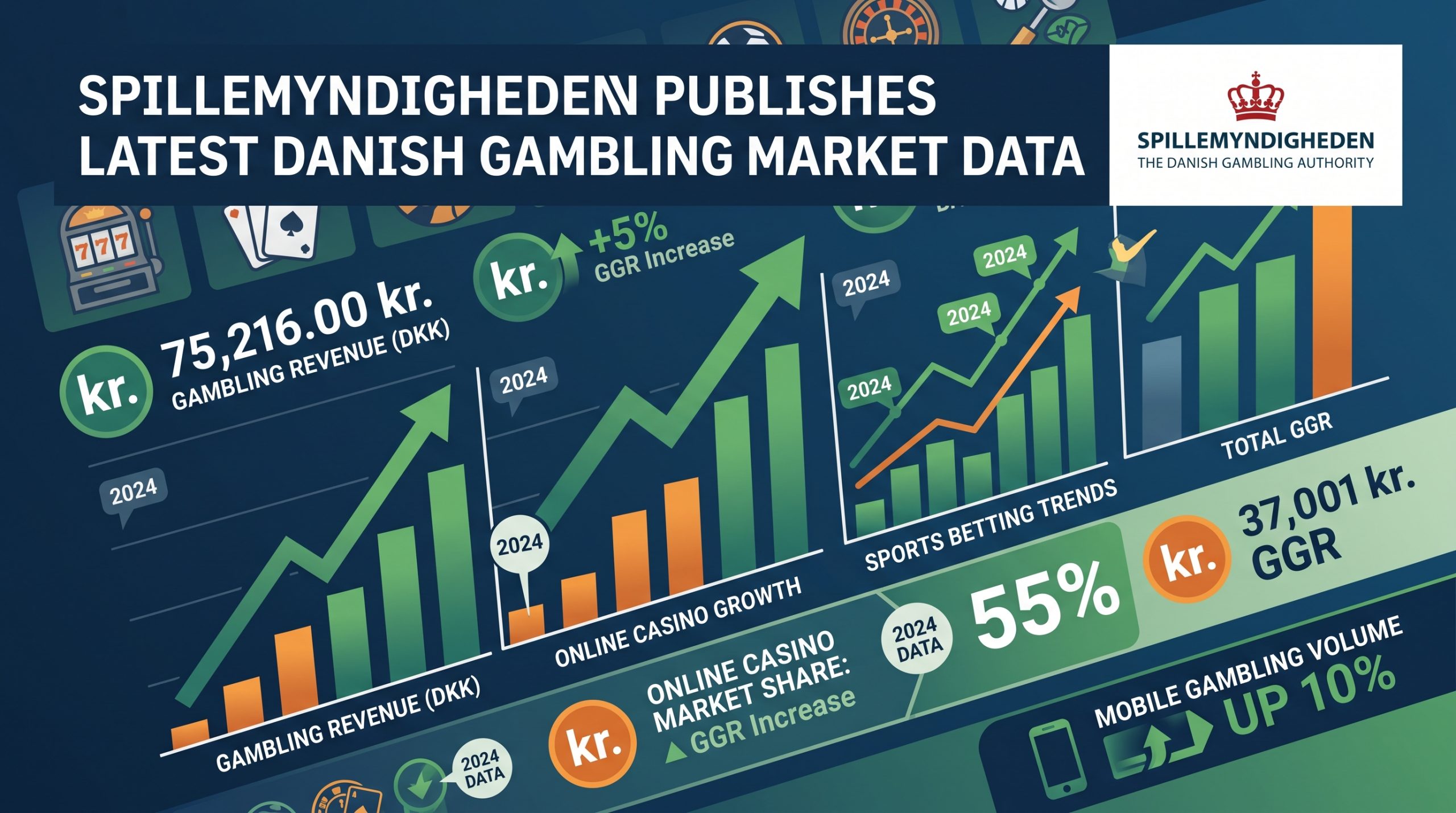
Denmark’s gambling regulator, Spillemyndigheden, has released its latest set of market statistics, offering operators, policymakers and analysts a fresh read on how the country’s regulated betting and gaming sectors are performing. The figures track revenue across the main verticals, from online casino to sports betting, and arrive as the Nordic market continues to draw scrutiny over channelisation and player protection. For an industry that lives and dies by trend lines, the numbers matter.
What the Danish Figures Signal for Operators
Before the detail, a short framing. The regulator’s periodic reporting is one of the few consistent public benchmarks for a market that otherwise plays its cards close. These takeaways focus on what the data means commercially, not just statistically.
- Online casino remains the growth engine. Across recent reporting periods, online casino has consistently outpaced other verticals in Denmark, and the pattern continues to shape where licensed operators direct marketing spend.
- Sports betting performance tends to swing with the fixture calendar, which means quarter-to-quarter comparisons can mislead anyone reading them in isolation.
- Channelisation is the real headline. High rates of play through licensed channels are what give the Danish model its credibility (a distinction regulators across Europe watch closely).
- Land-based gaming machines and the state-adjacent lottery segments continue to contribute meaningfully, even as attention gravitates toward digital.
- Stable or rising figures give the regulator leverage to argue that its framework is working as intended.
A Market Built on Partial Liberalisation
Denmark opened its betting and online casino markets to competition at the start of 2012, ending a long-standing monopoly structure and replacing it with a licensing regime overseen by Spillemyndigheden. That model has since become something of a reference point for other jurisdictions weighing how far to open their own markets. The regulator licenses operators, collects gambling duty, and publishes the aggregated data that underpins its public reporting.
The appeal of the Danish approach is straightforward. By pulling the bulk of activity into a taxed, supervised environment, the state captures revenue while retaining oversight of advertising, responsible-gambling tools and self-exclusion through the national ROFUS register. Operators accept tighter rules in exchange for legitimate access. That trade has held for more than a decade, and the latest statistics from the Danish Gambling Authority’s statistical reporting are the mechanism by which the public can judge whether it still holds.
But a decade of stability does not mean stasis.
Reading the Verticals
Danish market reporting is typically broken down into the core segments the regulator supervises. The relative weight of each tells its own story about player behaviour and operator strategy.
| Segment | Market role | What to watch |
|---|---|---|
| Online casino | Primary growth driver in recent periods | Sustained double-digit share expansion and the competitive pressure it places on margins across licensed brands |
| Betting | Large, cyclical vertical tied to the sporting calendar | Seasonal swings |
| Gaming machines | Land-based, venue-dependent | Footfall recovery |
| Lottery and charity games | Stable, state-linked contribution | Demographic shift |
The online casino story is the one most operators fixate on. Its continued expansion reshapes where acquisition budgets flow, and it raises a harder question for the regulator: how do you keep channelisation high in a vertical where unlicensed alternatives are a single click away?
Why the Numbers Carry Regulatory Weight
Statistics from a national regulator are never just an accounting exercise. They feed directly into policy. When Spillemyndigheden publishes figures showing healthy licensed-market activity, it strengthens the argument that the current framework protects players without strangling the commercial sector. When a segment slips, that gap becomes ammunition for tighter rules.
Advertising restrictions, deposit-limit debates and the design of self-exclusion tools all trace back, in part, to what the data shows. Denmark has leaned on responsible-gambling infrastructure as a core selling point of its model, and the credibility of that claim rests on measurable channelisation. In practice, a market that leaks players to unlicensed sites undermines both the tax base and the protection narrative at once.
That dual exposure is why channelisation, rather than raw revenue, is arguably the figure insiders read first.
The Competitive Backdrop
Denmark’s licensed field includes a mix of domestic names and international operators holding Danish permits. Competition is intense, particularly in online casino, where product breadth and bonus policy differentiate brands inside a tightly regulated advertising environment. Margins are pressured from two directions: gambling duty on one side, acquisition costs on the other.
And while the market is comparatively small by population, it punches above its weight as a proving ground for regulatory ideas. Jurisdictions still debating liberalisation look to Danish outcomes for evidence. A clean dataset showing high channelisation and stable revenue is worth more to that argument than any policy white paper.
What Comes Next
The immediate value of each statistical release is the trend it confirms or disrupts. Operators recalibrate forecasts. Regulators test whether their interventions are landing. Policymakers weigh whether the balance between commercial freedom and consumer protection needs adjusting.
The precedent Denmark has set gives other European regulators a template they have already shown interest in borrowing: open the market, tax it, measure it relentlessly, and publish enough to keep the model accountable. Whether the next figures reinforce that story or complicate it is the only question that really counts.
Frequently Asked Questions
Who is Spillemyndigheden?
Spillemyndigheden is the Danish Gambling Authority, the public body responsible for licensing gambling operators, collecting gambling duty and supervising the market. It also maintains Denmark’s national self-exclusion register, ROFUS.
When did Denmark open its gambling market?
The Danish betting and online casino markets were liberalised at the start of 2012, replacing a monopoly structure with a competitive licensing regime.
Which vertical leads the Danish market?
Online casino has been the standout growth segment in recent reporting, consistently outpacing betting and land-based gaming in expansion.
Why does channelisation matter so much?
Because it measures how much play stays inside the licensed, taxed and supervised system. High channelisation protects both state revenue and the player-protection framework; low channelisation erodes both at the same time.
How often are the statistics published?
The regulator reports on market performance periodically, giving operators and analysts a recurring public benchmark for tracking trends across verticals.