


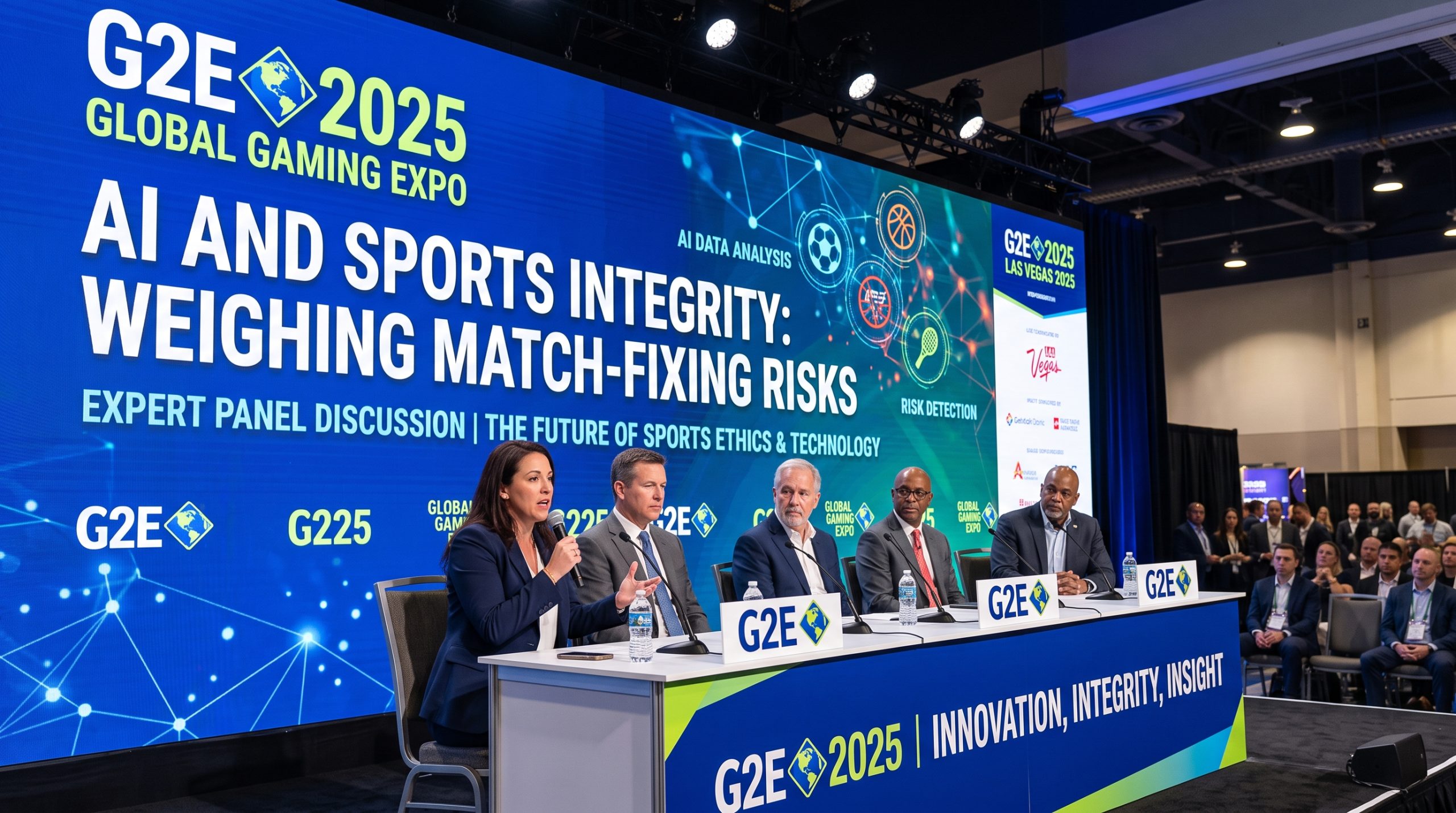
Artificial intelligence dominated conversation at the Global Gaming Expo (G2E) in Las Vegas on September 30, where Advanced Compliance Technology Director Susan Bala likened the technology to “a galloping horse that seems to be out of control.” Her panel at the Venetian Expo Center, titled “How AI is Transforming Sports Integrity and Match Fixing,” drew operators, regulators, and compliance specialists into a debate about how machine learning is reshaping the detection of corrupt betting activity. The discussion placed AI squarely at the intersection of two forces: a tool that catches match-fixers, and a tool that could help them hide.
Why the G2E AI Debate Matters for Operators and Regulators
Bala’s horse metaphor set the tone for a session that was less about hype and more about control. The question running underneath the panel was straightforward enough: who is steering?
- Detection is getting faster. AI-driven monitoring systems can scan betting markets in near real time, flagging irregular patterns that human analysts would take hours or days to isolate.
- The same capability cuts both ways. Bad actors can use generative and predictive tools to disguise suspicious wagering behaviour, raising the technical bar for integrity teams.
- Compliance budgets face pressure. Operators investing in AI monitoring must weigh the cost against regulatory expectations that are tightening across US jurisdictions.
- Governance gaps remain. There is still no uniform standard for how AI integrity tools should be validated or audited across the sports-betting sector.
A Technology Moving Faster Than Its Guardrails
Bala’s framing captured a tension that many in the room recognised. AI integrity systems now ingest betting flows, line movements, and account behaviour, then surface anomalies for human review. In practice, that means a flagged bet can trigger an alert before a match even ends.
But speed is not the same as certainty. A model that spots unusual activity still needs a human to decide whether that activity is fraud, coincidence, or a sharp bettor with good information (a distinction that regulators have been slow to codify). And while the tools improve, the people trying to beat them improve too.
That is the harder question the panel kept circling back to: as detection models learn, so do the networks they are built to catch. Which raises a more uncomfortable point about parity. If both sides are training on similar techniques, the advantage may belong to whoever moves first.
Sports Integrity Under a New Kind of Scrutiny
Match-fixing is not new. What has changed is the volume and velocity of data that integrity monitors must process. Legal US sports betting has expanded to dozens of states since the 2018 Supreme Court decision in Murphy v. NCAA struck down the federal ban, and with that expansion came a far larger surface area for manipulation.
Integrity firms argue that AI is the only realistic way to police markets at this scale. Human analysts simply cannot watch every market on every event. Still, the reliance on automated systems introduces its own exposure: a false positive can wrongly implicate a player or operator, while a false negative lets corruption slip through unseen.
Companies working in this space, including firms represented at the annual Global Gaming Expo in Las Vegas, have begun positioning AI monitoring as a core compliance product rather than an optional add-on. That shift signals where the market expects regulatory pressure to land next.
The Business Case Behind AI Integrity Tools
For operators, the calculation is partly reputational and partly financial. A single high-profile fixing scandal can erode consumer trust and invite regulatory penalties. AI monitoring, at least on paper, lowers that risk by catching anomalies early.
The table below outlines where AI is already changing integrity workflows against where friction remains.
| Function | AI Contribution | Remaining Challenge |
|---|---|---|
| Market monitoring | Real-time anomaly detection across thousands of simultaneous markets | Separating genuine fraud from legitimate sharp betting activity, which still demands human judgement and context |
| Pattern analysis | Historical modelling of fixing signatures | Adversaries adapting to known patterns |
| Alert triage | Automated prioritisation of suspicious cases | False positives and limited transparency |
| Reporting | Faster evidence packaging for regulators | No common audit standard |
Which is where the economics get interesting. The firms that can prove their models are auditable may command a premium in a market that increasingly treats integrity as a licensing condition.
What Regulators Are Likely to Do Next
Regulatory bodies have signalled growing interest in how AI is deployed within gambling compliance, though formal frameworks remain thin. The precedent being set at industry gatherings like G2E gives regulators a template they can draw on when they move to codify expectations around model validation and data governance.
Expect three pressure points to surface first: transparency of algorithmic decision-making, accountability for automated flags, and standards for how integrity data is shared between operators and leagues. None of these are settled. All of them carry direct cost implications for the businesses that must comply.
And here is the stance worth stating plainly. An integrity system no one can audit is not an integrity system. It is a black box with a good marketing story.
Frequently Asked Questions
What was discussed at the G2E 2025 AI panel?
The panel, held September 30 at the Venetian Expo Center, examined how artificial intelligence is transforming sports integrity and match-fixing detection. Advanced Compliance Technology Director Susan Bala led the discussion and described AI as “a galloping horse that seems to be out of control.”
How does AI help detect match-fixing?
AI systems monitor betting markets in near real time, flagging irregular patterns in wagering activity, line movements, and account behaviour. Human analysts then review those alerts to determine whether the activity reflects genuine corruption.
Can AI also be used by match-fixers?
Yes. The same predictive and generative capabilities that power detection can help bad actors disguise suspicious betting behaviour, which is one reason the panel treated AI as both a solution and a risk.
Are there regulations governing AI in sports betting integrity?
Not comprehensively. There is currently no uniform standard for validating or auditing AI integrity tools, though regulators have shown rising interest in the area.
Why does this matter for gambling operators?
A single fixing scandal can damage consumer trust and trigger penalties. AI monitoring reduces that exposure, but it also introduces risks around false positives and limited transparency that operators must manage.


