


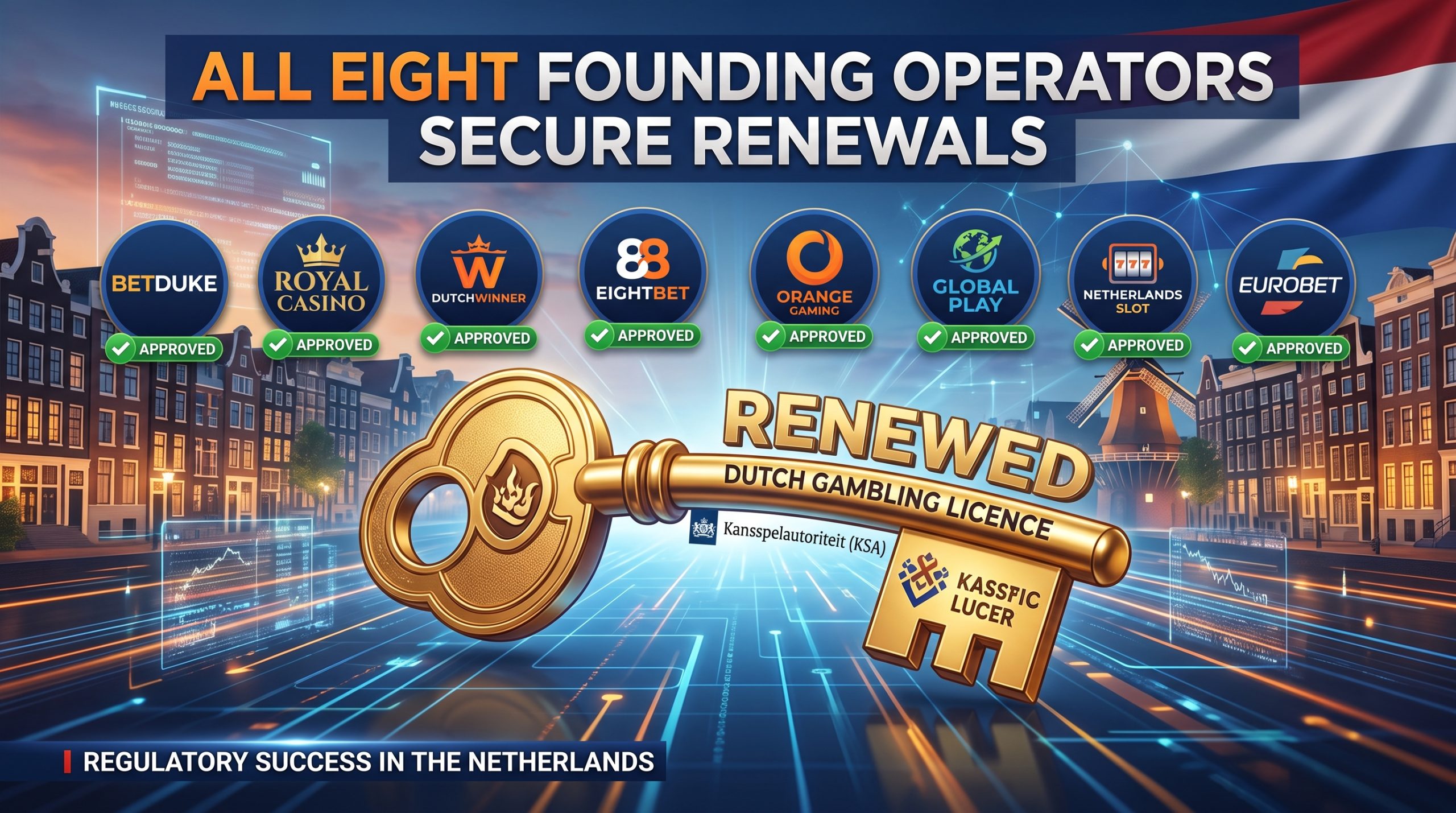
Every operator that entered the regulated Dutch online gambling market at its launch has now had its licence renewed by the Kansspelautoriteit (KSA), the country’s gaming regulator. The renewals cover all eight companies that went live when the market opened on 1 October 2021, closing a first five-year licensing cycle that began under intense regulatory scrutiny. For operators, the decisions confirm continuity in one of Europe’s more tightly supervised online markets. For the KSA, they mark the first full test of its renewal machinery.
The Netherlands built its framework around the Remote Gambling Act (Wet Kansspelen op afstand, or Koa), legislation that took years to move from proposal to enforcement. What happened this cycle tells you how the regulator now reads its own rulebook.
What the Renewals Mean for the Dutch Market
Before the individual approvals, the picture was straightforward on paper and complicated in practice: eight licences issued in 2021, all expiring roughly five years later, all requiring the regulator to reassess suitability, financial standing, and player-protection compliance. The renewals answer the immediate commercial question. They leave a harder one open.
- Continuity secured: All eight founding operators retain their legal footing to offer online games of chance to Dutch consumers, removing near-term uncertainty over market exits or forced re-tendering.
- A benchmark set: The KSA has now demonstrated a working renewal process, giving later entrants a clearer read on what compliance over a full licence term actually requires.
- Player-protection performance mattered. Renewal is not automatic under Koa, and each operator had to satisfy the regulator on responsible-gambling obligations.
- Signal to newer licensees: Firms that joined after October 2021 face the same bar, and the founding cohort’s outcomes arguably form the reference point regulators will apply.
A Framework Built Slowly, Enforced Firmly
The Dutch market did not open in a hurry. The Koa passed after prolonged legislative debate, and the KSA spent the following years building an enforcement posture that has become one of the stricter ones in the European Union. Advertising restrictions tightened. Deposit-limit rules and duty-of-care expectations grew more demanding. And while eight operators formed the founding group, the licensed population has since expanded well beyond that number.
That context shapes how the renewals should be read. A licence granted in 2021 was, in effect, granted under one set of expectations. A renewal in 2026 is measured against a heavier compliance load. Operators including the state-owned Holland Casino online gambling platform operate within a system where the regulator has repeatedly shown it will act on breaches rather than warn indefinitely.
Which raises a harder question: does renewal certify past conduct, or forecast future compliance? The KSA’s decisions suggest it treats the two as inseparable.
Regulatory Pressure Is Not Easing
The renewals arrive against a backdrop of continued tightening rather than relaxation. Dutch policymakers have discussed further curbs on advertising and stricter affordability checks, and the KSA has issued penalties to unlicensed operators targeting Dutch players. The regulator’s public position has been consistent: access to the legal market is a privilege conditioned on demonstrable player protection, not a commercial entitlement.
For the eight founding operators, staying licensed is one thing. Staying comfortable is another.
The financial stakes are real. A revoked or non-renewed licence would cut an operator off from a regulated market that channels significant consumer spend through legal channels, forcing either a costly reapplication or a full exit. That commercial reality gives the KSA leverage that fines alone do not. The threat of losing market access, in practice, disciplines behaviour more reliably than any single penalty.
How the Dutch Model Compares
The Netherlands sits among a group of European jurisdictions that pair licensing with active enforcement rather than treating a licence as a one-time gate. The table below outlines the broad shape of the Dutch approach relative to common regulatory features.
| Feature | Dutch Approach (Koa framework) |
|---|---|
| Licence term | Fixed multi-year term requiring formal renewal, not automatic rollover |
| Renewal basis | Reassessment of suitability, financial standing and responsible-gambling compliance across the full prior term |
| Advertising | Progressively restricted, with limits on untargeted and high-visibility promotion |
| Enforcement stance | Active penalties against both licensed breaches and unlicensed operators targeting Dutch consumers, backed by the ultimate sanction of market removal |
| Player protection | Duty-of-care obligations, deposit controls and central self-exclusion via the Cruks register |
What Happens Next
With the founding cohort renewed, attention shifts to the wider licensee base and to whether the KSA applies the same standard uniformly. The precedent set here gives the regulator a template it has already signalled interest in using. Newer entrants now know what a full licence cycle looks like from start to finish, and they know renewal is earned rather than assumed.
Still, the direction of Dutch policy remains upward in strictness. Operators planning around the Netherlands should budget for compliance costs that rise over time, not plateau.
Frequently Asked Questions
Which operators had their licences renewed?
All eight operators that were active at the re-regulation of the Dutch online gambling market on 1 October 2021 have now received renewals from the Kansspelautoriteit.
Is licence renewal in the Netherlands automatic?
No. Under the Remote Gambling Act, operators must satisfy the KSA on suitability, financial standing and responsible-gambling compliance. A licence can be denied or revoked where those standards are not met.
Who is the Dutch gambling regulator?
The Kansspelautoriteit (KSA) supervises and enforces the Dutch gambling market, including licensing, advertising rules and action against unlicensed operators.
Why do these renewals matter for the wider market?
They confirm a functioning renewal process and establish how the regulator weighs a full term of conduct. That outcome effectively sets the expectation for every other licensee facing the same review.


