


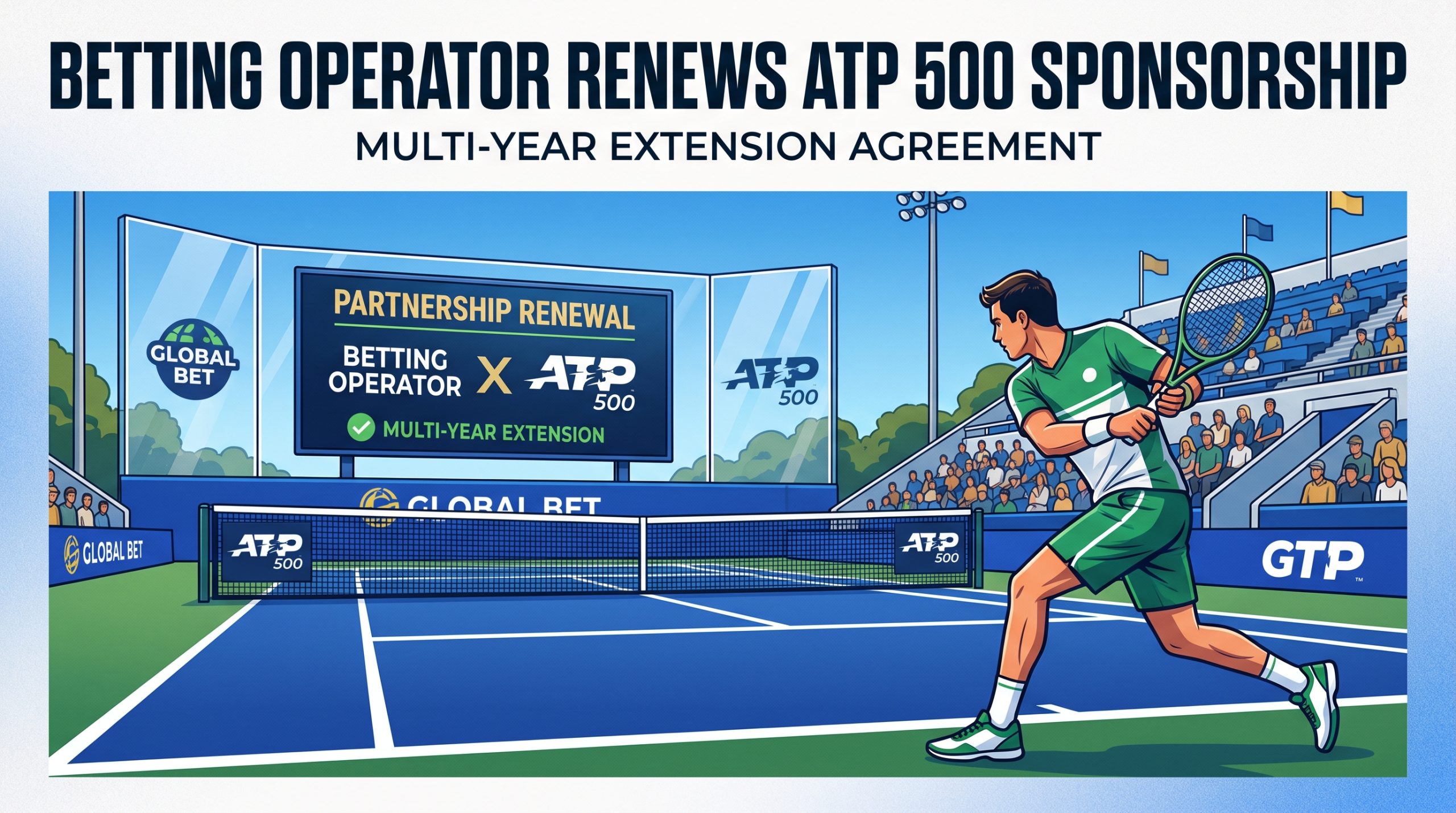
A gambling operator has renewed its partnership with an ATP 500 tennis tournament, extending an agreement that keeps the brand attached to one of the men’s professional circuit’s higher-tier events. The extension continues a commercial relationship built around courtside visibility, digital activation, and the tour’s growing audience across broadcast and streaming. For both sides, the deal reflects a familiar bet: tennis delivers a global, high-engagement audience, and betting brands pay to sit inside it.
What the renewal does not change is the underlying tension around gambling money in sport. That tension is not going away.
What the Renewal Signals for Sponsorship Strategy
Before the specifics, the strategic read. Sponsorship extensions of this kind rarely happen in isolation, and the decision to re-commit to an ATP 500 property carries implications for how betting operators are allocating marketing spend across the sports calendar.
- Retention over acquisition: Extending an existing deal is cheaper and lower-risk than chasing a new property, and it signals the operator judged the first term worth repeating.
- Tennis remains a priority vertical for betting brands because matches generate near-continuous in-play markets, point by point, across a long season.
- The ATP 500 tier sits below the Masters 1000 and Grand Slam events but offers stronger reach than the ATP 250 category, a middle ground where sponsorship costs and audience size arguably balance out.
- Regulatory exposure is now part of the calculus: operators weigh advertising restrictions in key markets before committing multi-year budgets.
- Continuity matters to fans, and brand recall builds over repeated tournament cycles rather than a single appearance.
Why Tennis Keeps Attracting Betting Money
Tennis and betting operators have a long, entangled history. The sport’s structure suits the product: individual matches, frequent momentum swings, and a scoring system that resets constantly create a steady supply of in-play wagering opportunities. A single three-set match can generate hundreds of distinct betting markets, which is precisely what live-betting platforms need.
And the audience travels well. ATP events draw viewers across Europe, Asia, and the Americas, giving sponsors reach that few individual sports match at comparable cost. For an operator working to grow name recognition in multiple regulated markets at once, a tennis property does a lot of work with one logo placement.
Still, the relationship is not frictionless. Tennis has faced persistent scrutiny over match-fixing and integrity concerns, and the presence of betting sponsors on the same courts where integrity is policed remains a point critics return to (a distinction the sport’s governing bodies have worked to keep visible). The official ATP Tour tennis calendar and event listings continue to feature commercial partners from the betting sector across multiple tournaments.
The Regulatory Backdrop Cannot Be Ignored
Betting sponsorship in sport is under review in several jurisdictions, and the direction of travel is toward tighter controls rather than looser ones. Operators signing multi-year deals now are effectively pricing in the possibility that the rules governing where and how their brand appears may shift before the term expires.
Consider the range of approaches already in force or under discussion:
| Market | Approach to Betting Sponsorship |
|---|---|
| United Kingdom | Voluntary front-of-shirt ban in football from the 2026/27 season; ongoing debate over broader advertising limits following the Gambling Act review |
| Italy | Comprehensive prohibition on gambling advertising and sponsorship since 2019 under the Dignity Decree, one of the strictest regimes in Europe |
| Spain | Sharp restrictions on advertising windows and sponsorship since 2021 |
| Germany | Licensing framework with advertising limits under the interstate gambling treaty |
A cross-border sport such as tennis complicates all of this. A logo permitted at a tournament in one country may fall foul of advertising rules when the broadcast crosses into another. Which raises a harder question for operators: how do you value a sponsorship whose visibility depends on a patchwork of national regimes that keep moving?
Business Impact for the Tournament and the Operator
For the event organiser, a renewed sponsorship means budget certainty. Tournaments rely on a mix of commercial partners, gate receipts, and media revenue, and a returning betting sponsor secures a known line in that ledger without the cost of a fresh sales cycle. Predictable income lets organisers plan facility upgrades, prize money, and hospitality with more confidence.
For the operator, the return is measured in reach and association. Being tied to a recognised ATP 500 event lends a degree of legitimacy that pure performance advertising cannot buy. But the value depends on activation. A static logo does little; a sponsorship supported by odds integration, content, and promotional campaigns around the tournament does considerably more.
The commercial logic holds only if regulation stays broadly stable in the operator’s core markets. That is the wager underneath the wager.
Frequently Asked Questions
What is an ATP 500 event?
ATP 500 tournaments sit in the second tier of the men’s professional tennis circuit, ranking below the Grand Slams and Masters 1000 events but above the ATP 250 category. The number reflects the ranking points awarded to the champion.
Why do betting companies sponsor tennis?
Tennis produces a continuous stream of in-play betting markets thanks to its point-by-point scoring, and it delivers a large international audience. That combination makes the sport unusually well suited to operators selling live wagering.
Is betting sponsorship in tennis restricted anywhere?
Yes. Italy bans gambling advertising and sponsorship outright, while Spain, Germany, and the UK apply varying limits. Because tennis is broadcast globally, a single sponsorship can be subject to several regulatory regimes at once.
How long does the renewed agreement run?
The parties have described the deal as a multi-year extension. Specific financial terms have not been publicly disclosed.
What Comes Next
The renewal buys stability for both parties, but the environment around gambling sponsorship in sport is anything but static. Regulators across Europe have already shown a willingness to move, and each new restriction narrows the space in which betting brands can operate on the sports stage. Operators that keep re-committing to tennis are betting the audience is worth the compliance headache.
Whether that math still works in five years is the part nobody can sign for yet.


