





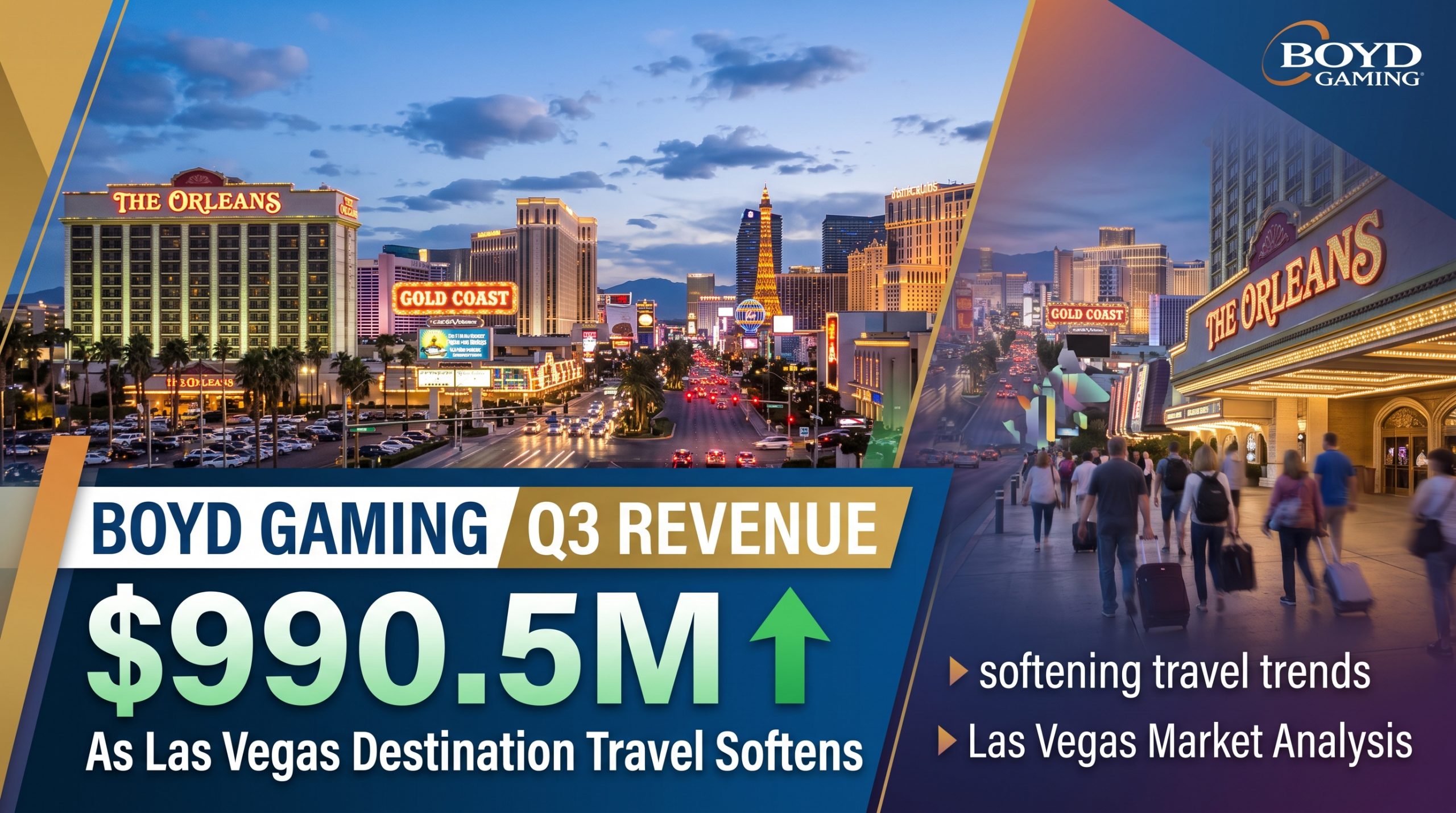
Boyd Gaming reported $990.5 million in revenue for the third quarter of 2026, a modest dip from the same period last year, pointing to weaker destination travel to Las Vegas as the main drag on performance. The Las Vegas-based operator singled out its Orleans property, which caters heavily to out-of-town visitors, as the segment most affected. For a company with casino interests spread across more than ten states, the result raises a familiar question for the sector: how much of the slowdown is local, and how much is structural?
What the Q3 Numbers Signal for Operators
Before the bullet points, the short version. Revenue held near the billion-dollar mark, but the direction of travel matters more than the headline figure. The softness was concentrated, not broad, and that distinction shapes how investors should read the quarter.
- Destination weakness is specific: The pullback hit Las Vegas visitation hardest, with The Orleans absorbing the most pressure rather than the portfolio as a whole.
- Local and regional properties appear to have cushioned the decline, a reminder that Boyd’s diversified footprint is doing exactly what it was built to do.
- Margins remain the watchpoint: A revenue dip tied to lower-margin destination traffic can still preserve profitability if cost discipline holds.
- The company framed the quarter as a short-term headwind, not a reset of its longer trajectory.
A Portfolio Built to Absorb Shocks
Boyd operates a mix of Las Vegas Strip-adjacent, downtown, and regional casino assets. That spread is the point. When fly-in visitors thin out, properties serving nearby residents tend to hold steadier, because their demand is less sensitive to airfare, vacation budgets, and the general mood of discretionary travel.
The Orleans sits in an awkward middle. It draws a meaningful share of destination guests, which makes it more exposed when travel softens than a purely locals-focused casino would be. And while one property stumbling is not a crisis, it is a useful stress test. Boyd has spent years diversifying precisely so a single market’s bad quarter doesn’t dictate the company’s story.
Reading the Las Vegas Slowdown
The destination travel question extends well beyond one operator. Visitation to Las Vegas is shaped by consumer confidence, convention calendars, and the price of getting there. Boyd’s commentary suggests the current softness is on the demand side rather than anything to do with supply or competition.
That matters because demand-driven dips tend to be cyclical. They come back when conditions improve. What remains less clear is the timing, and no operator has a reliable way to forecast when leisure travellers decide Las Vegas is worth the trip again.
| Metric | Q3 2026 | Context |
|---|---|---|
| Total revenue | $990.5 million | Slight decline year-over-year, attributed to destination softness |
| Most affected property | The Orleans | Carries higher exposure to out-of-town Las Vegas visitors than locals-focused venues |
| Primary cause cited | Destination travel weakness | Demand-side pressure on leisure trips to Las Vegas |
Why This Quarter Carries Weight
Investors watching the regional gaming sector have been looking for signs that the post-pandemic travel boom is normalising. Boyd’s quarter offers one data point in that direction. A near-billion-dollar result with a narrow soft spot is hardly alarming, yet it hints that the extraordinary demand of recent years may be settling into something more ordinary.
The company’s management positioned the quarter as manageable, emphasising that the weakness was contained. Whether rivals report a similar pattern will tell the broader story. If destination softness shows up across operators, the sector is looking at a cyclical cooling. If it stays confined to specific properties and markets, the explanation is more about individual positioning than industry-wide strain.
You can track the company’s property portfolio and investor disclosures through its Boyd Gaming corporate operations across multiple US markets, which spans locals-oriented casinos, downtown Las Vegas venues, and regional destinations.
The Diversification Payoff in Practice
There is a quiet lesson buried in these numbers. Operators that built their footprint around a single market take the full force of any downturn in that market. Boyd, by contrast, can report a soft quarter in one segment while other parts of the business keep the overall figure close to prior-year levels.
In practice, that resilience is the difference between a company that reports a crisis and one that reports a headwind. The vocabulary alone tells you how exposure is distributed. Regional and locals casinos generate steadier, more predictable foot traffic because their customers live nearby and visit out of habit rather than as part of a planned vacation. That stability doesn’t produce spectacular growth, but it does smooth out the dips. And in a quarter defined by travel softness, smooth is valuable.
Frequently Asked Questions
How much revenue did Boyd Gaming report in Q3 2026?
Boyd Gaming reported $990.5 million in third-quarter 2026 revenue, a slight decline from the same quarter a year earlier.
Why did revenue fall?
The company attributed the dip to increased softness in destination travel to Las Vegas, which affected its Orleans property more than others.
Is this a problem across the whole company?
No. Boyd described the weakness as concentrated rather than broad, with its diversified portfolio of locals and regional casinos helping offset the Las Vegas destination pressure.
What does this mean for the wider gaming sector?
It depends on whether competitors report the same pattern. A single operator citing destination softness could reflect property-specific exposure, but a sector-wide trend would point to cyclical cooling in Las Vegas leisure travel.
Which property was most affected?
The Orleans, which draws a significant share of out-of-town visitors and is therefore more sensitive to swings in destination travel demand.


