





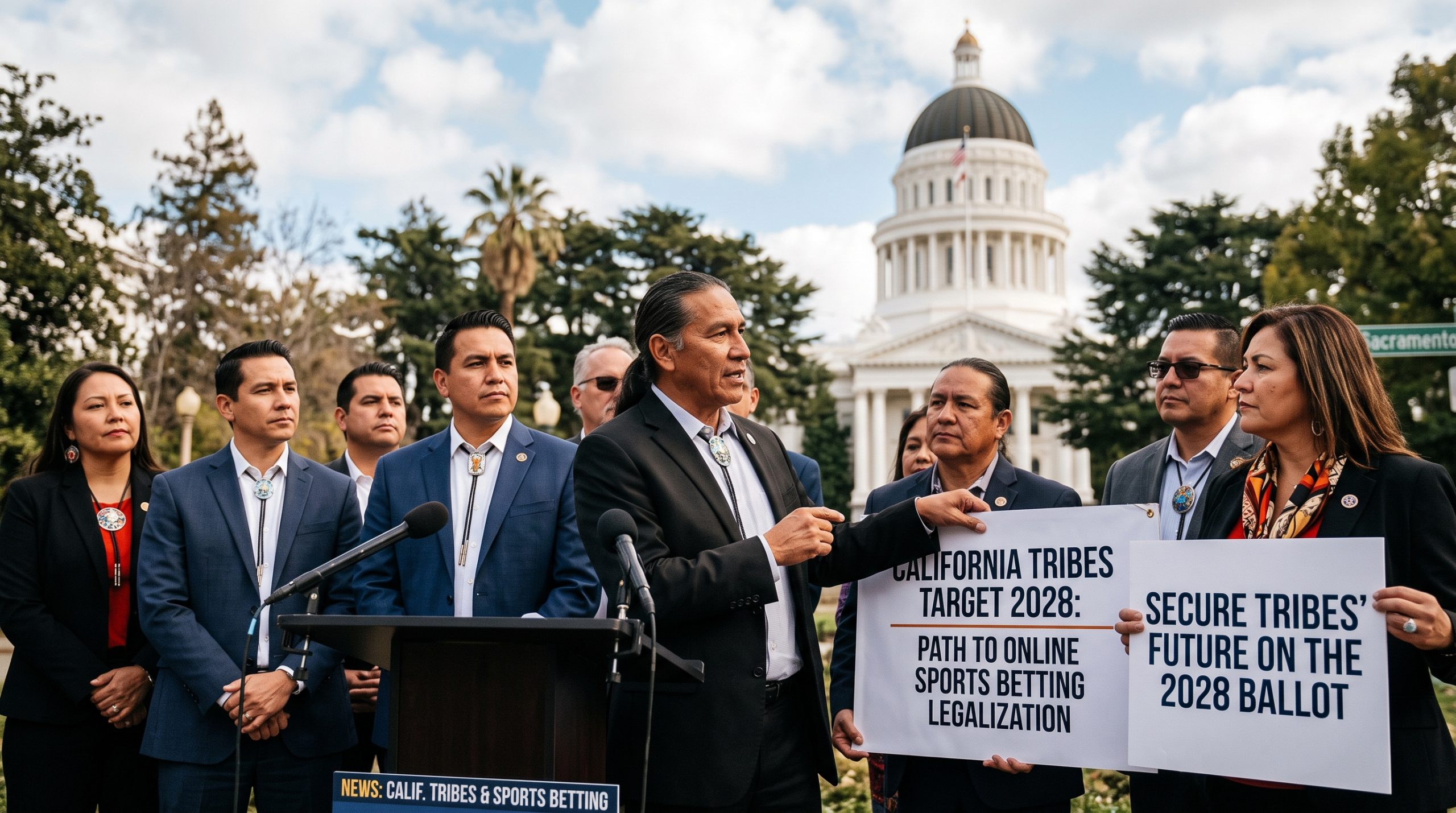
California’s tribal gaming leaders have set a target: 2028. James Siva, chair of the California Nations Indian Gaming Association (CNIGA), used an appearance on the New Normal podcast Wednesday to lay out the tribes’ intention to bring an online sports betting measure before state voters that year. The podcast is hosted by Indian Gaming Association Conference Chair Victor Rocha and Executive Director Jason Giles. For an industry still bruised from the last attempt, the announcement matters because it signals who intends to hold the pen this time.
What the 2028 Timeline Signals for Operators
The date itself is the message. By naming 2028 rather than 2026, tribal leaders are telling commercial operators that they do not intend to be rushed, and that any framework will be built on tribal terms first. The last serious push, in 2022, ended in a rout. Two competing propositions collapsed at the ballot after roughly $450 million in combined campaign spending, one of the most expensive initiative fights in American history.
- Tribal control is the through-line. Siva’s framing places California tribes as the authors of any 2028 measure, not passengers on an operator-led campaign.
- Commercial sportsbooks that spent heavily in 2022 will need to negotiate rather than dictate.
- Time is the strategy. A 2028 window gives tribes room to build consensus across more than 100 federally recognized tribes in the state before any language is filed.
- California remains the largest untapped legal sports betting market in the country, a prize worth waiting for.
Why the 2022 Collapse Still Shapes the Conversation
You cannot read the 2028 plan without the 2022 wreckage in view. Proposition 26, the tribal-backed retail measure, and Proposition 27, the operator-backed online measure, both failed decisively. Voters rejected Prop 27 by a margin north of 80 percent. The two camps spent the campaign attacking each other, and the electorate, arguably confused by dueling ads, said no to everything.
That outcome left a lesson that Siva’s comments now echo. A divided industry loses. And while national operators have the marketing budgets, they lack the constitutional standing that tribes hold over gaming on sovereign land in California.
The California Nations Indian Gaming Association’s membership of gaming tribes represents the bloc that any successful measure will need to satisfy first. Without that alignment, history suggests the money simply burns.
The Business Calculus Behind a Tribal-Led Model
Here is the harder question: what does an online sports betting market look like when tribes set the rules?
Several structures are possible, and each carries different implications for commercial brands hoping to enter. Under a tribal-exclusive model, operators like FanDuel and DraftKings would likely function as skins or technology partners tethered to tribal licenses rather than direct license holders. That arrangement mirrors how digital wagering has been threaded through tribal compacts in other states, though the revenue splits and control provisions vary widely in practice.
| Element | 2022 Approach | Anticipated 2028 Direction |
|---|---|---|
| Lead sponsor | Split between tribes (Prop 26) and operators (Prop 27) | Tribal coalition |
| Market type | Retail vs. online, competing measures | Online, structured around tribal authority |
| Campaign spend | Roughly $450 million, largely spent attacking the opposing measure rather than persuading voters | Not disclosed |
| Voter outcome | Both measures failed | To be determined |
The economics are substantial. Analysts have long pegged California as a market capable of generating billions in annual handle once live. But the size of the prize is precisely why coordination has been so difficult: everyone wants in, and no single party can deliver the market alone.
Regulatory and Sovereignty Considerations
Any online expansion touches the Indian Gaming Regulatory Act (IGRA) and the state’s tribal-state compacts. Online wagering complicates the geography question that IGRA was built around, because a bet placed on a phone in Los Angeles is not obviously a bet placed on tribal land. That legal ambiguity was a friction point in 2022 and has not gone away.
Tribes will want any 2028 framework to preserve their exclusivity and sovereignty while still passing constitutional muster. A measure that voters approve but courts later unwind would be worse than no measure at all. So the drafting matters as much as the campaign.
What Comes Next Before Any Vote
Siva’s announcement opens a negotiation, not a countdown. Between now and 2028, expect quieter movement: coalition-building among tribes, exploratory conversations with commercial operators, and polling to test what language voters might actually accept. The Indian Gaming Association’s national platform for tribal gaming policy gives leaders a venue to shape that messaging well ahead of any filing.
For operators, the read is straightforward. Patience and partnership beat confrontation. The brands that spent 2022 fighting tribes may find that the fastest route into California runs through the very coalition they once opposed.
Whether that détente holds is the open part.
Frequently Asked Questions
When could online sports betting go live in California?
No sooner than after a successful 2028 ballot measure, and likely later still, given the time needed for regulatory implementation and compact adjustments. There is no confirmed launch date.
Why did the 2022 measures fail?
Voters rejected both Proposition 26 and Proposition 27. A divided industry spent heavily attacking rival measures, and confused voters declined all of it, with Prop 27 losing by more than 80 percent.
Will companies like FanDuel and DraftKings be able to operate?
Possibly, but most likely as partners operating under tribal authority rather than as independent license holders. The exact structure has not been finalized.
Who is James Siva?
He chairs the California Nations Indian Gaming Association, the trade body representing gaming tribes across the state. He made the 2028 comments on the New Normal podcast.
Is a 2026 measure ruled out?
Siva’s public focus points to 2028. Tribal leaders appear to favor a longer runway to build consensus before committing to ballot language.


