



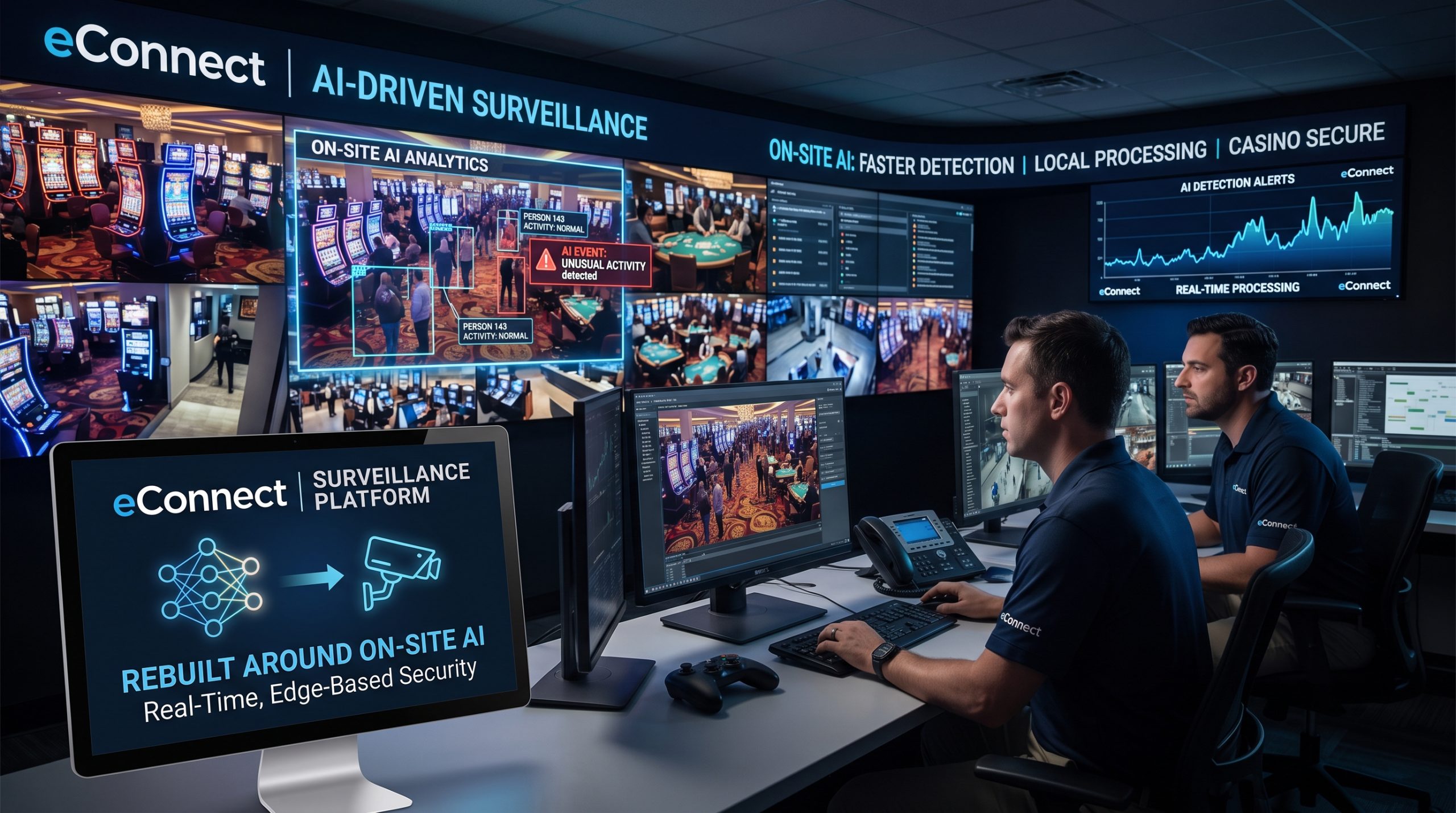
eConnect, a Las Vegas-based surveillance and operations technology vendor serving casino operators, has rebuilt its platform from the ground up around artificial intelligence while keeping sensitive gaming data inside the property rather than in the cloud. President and CEO Henry Valentino outlined the decision in an interview with CDC Gaming, framing it as a response to two pressures operators rarely reconcile: the appetite for AI-driven analytics and the reluctance to let regulated data leave the building. The move positions on-premise processing as a competitive feature at a moment when most enterprise software is moving the other way.
What the Rebuild Means for Casino Operators
The headline here is not a new feature bolted onto old software. It is a decision to tear down the foundation and start again.
- Data stays on-site. Sensitive casino information is processed locally, which sidesteps the regulatory and reputational exposure of transmitting gaming data to external servers.
- AI was treated as the architecture, not an add-on. Valentino says the platform was rebuilt from scratch specifically so machine-driven analysis could run natively.
- Surveillance and operations converge. The same system opens new use cases across security monitoring and day-to-day floor management, collapsing tools that often sit in separate silos.
- Legacy debt gets retired. Rebuilding rather than patching removes years of accumulated workarounds that slow older platforms.
Why On-Premise AI Cuts Against the Cloud Grain
The broader software industry has spent a decade migrating workloads to the cloud. Casinos, operating under strict jurisdictional data rules, have reasons to hesitate. Surveillance footage, player identification, and transaction records carry compliance weight that few operators want traveling across third-party infrastructure.
By keeping inference and analysis local, eConnect’s casino surveillance technology avoids the question of who else can touch the data in transit. That matters in an environment where gaming boards scrutinise data handling closely (a distinction regulators have been slow to codify in plain terms, but one operators feel acutely). The trade-off is real: on-premise AI demands more capable hardware at the property and a heavier engineering lift than renting cloud compute.
Still, for a sector where a single data-handling misstep can trigger a licensing review, the calculus shifts. Control, in this context, is worth paying for.
The Business Case Behind Building From Scratch
Rebuilding a platform is expensive and slow. Vendors usually resist it, preferring to extend what already works. Valentino’s argument is that retrofitting AI onto a system designed for an earlier era produces friction that eventually caps performance. A ground-up build, by contrast, lets the data model and the analytics layer speak the same language from the start.
That shift matters because the value of surveillance AI depends on speed and accuracy at scale. A casino floor generates a continuous stream of behavioural signals. Catching the ones that matter in near real time is the whole point.
| Dimension | Legacy approach | eConnect’s rebuilt model |
|---|---|---|
| Data location | Increasingly cloud-based | Processed on-site at the property |
| AI integration | Added onto existing systems | Native to the architecture, built in from the first line of code rather than layered on afterward |
| Primary use | Surveillance-focused | Surveillance plus broader operations |
| Regulatory exposure | Data-in-transit risk | Reduced external data movement |
Surveillance Meets Operations on a Single Floor
The convergence Valentino describes is arguably the part operators should watch most closely. Surveillance teams and operations teams have historically worked from different screens, different vendors, and different incentives. One hunts for threats. The other chases efficiency.
Fold both into one AI-driven platform and the economics change. The same camera feed that flags a security concern can, in principle, inform staffing, table utilisation, and player service. What remains less clear is how operators will govern that dual use internally, since the line between protective monitoring and operational analytics is not always comfortable to draw.
Reading the Market Signal
eConnect’s bet lands at a specific moment. Casino operators are under commercial pressure to extract more from their floors while staying inside tightening compliance frameworks. A vendor offering AI capability without the cloud trade-off speaks directly to that tension.
The precedent is useful for competitors too. If on-premise AI proves it can match cloud performance for surveillance workloads, other vendors face a harder sales conversation about where client data actually lives. And in a regulated industry, where the data sits is rarely a technical footnote.
Three video highlights accompanying the CDC Gaming interview walk through the rationale, the architecture choices, and the operational possibilities the rebuild opens. The throughline across all three is consistent: build for AI, keep the data home.
Frequently Asked Questions
What did eConnect actually change?
The company rebuilt its surveillance and operations platform from the ground up so that AI runs as part of the core architecture, while sensitive casino data is processed on-site rather than in the cloud.
Why keep data on-premise instead of in the cloud?
Casinos operate under strict data-handling rules, and moving gaming data to external servers introduces regulatory and reputational risk. Processing locally keeps that data inside the property and reduces exposure during transit.
Who is behind the decision?
Henry Valentino, President and CEO of eConnect, outlined the strategy in an interview with CDC Gaming.
Does on-premise AI cost more?
It can. Running AI locally requires more capable hardware at the property and a heavier engineering effort than renting cloud compute. For operators worried about compliance, many view that cost as justified.
How does this affect casino operations beyond security?
The rebuilt platform merges surveillance with operational analytics, meaning the same system can support both threat detection and floor-management decisions from a single data source.