


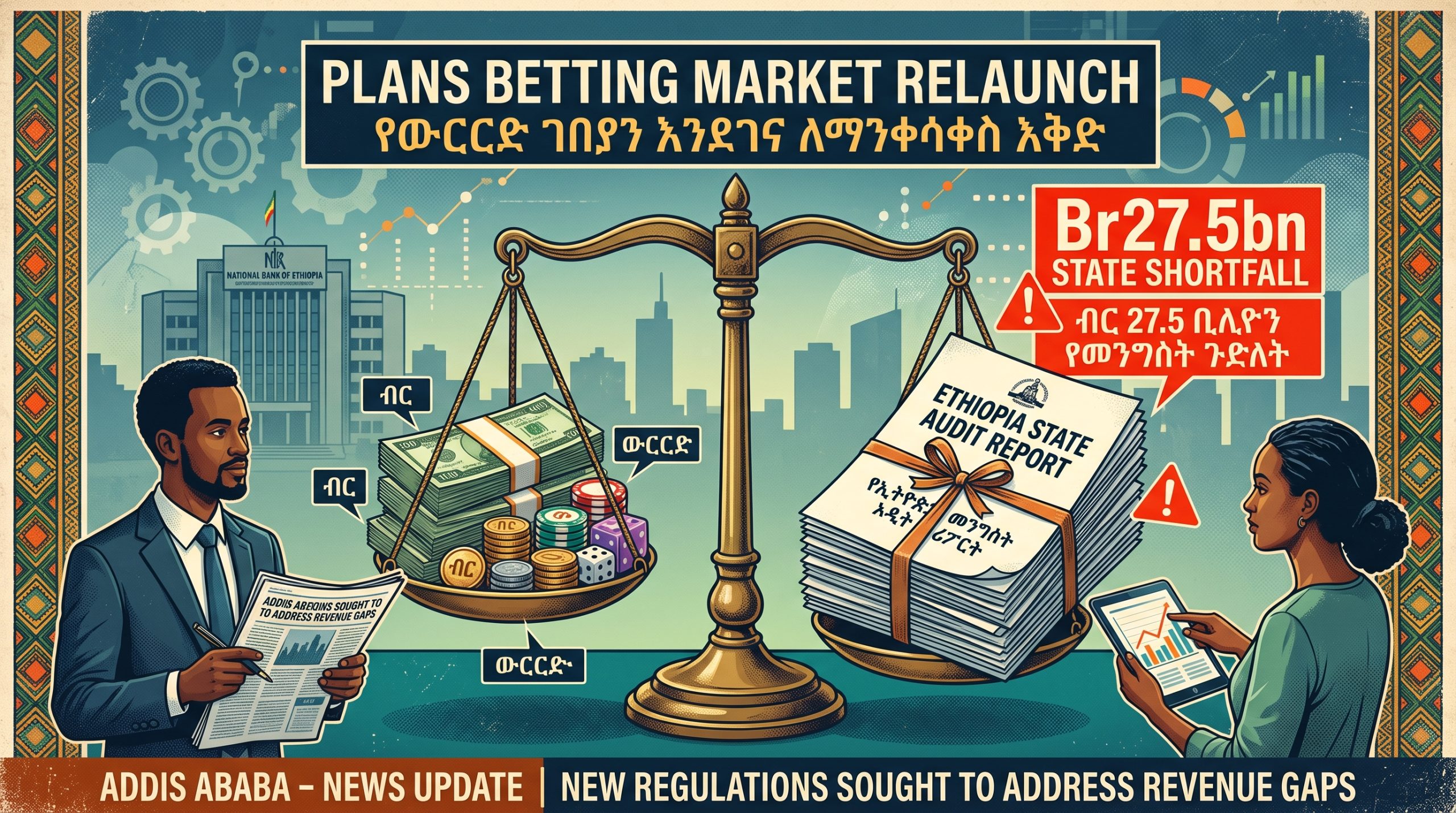
Ethiopia is preparing to reopen its sports betting and digital lottery market under stricter oversight, months after a draft government audit identified a reported Br27.5 billion shortfall in payments owed to the state. The overhaul is being led by the Ethiopian Lottery Service, the country’s betting and lottery regulator, following its decision to revoke every sports betting licence in December 2025. Enforcement action against operators continues, and at least one legal challenge is working its way through the courts. No reopening date has been set.
What the Overhaul Means for Operators and the State
The relaunch is not a quiet administrative reset. It follows a near-total shutdown of the sector, a provisional audit alleging large unpaid liabilities, and a jurisdictional fight over who should govern betting in the first place. For anyone watching the market, the signal is clear enough: re-entry will carry conditions that did not exist before.
- Market access is frozen. As of July, the regulator confirmed no operator held a valid licence, and no new application process has opened.
- Financial exposure is substantial. The draft audit alleges operators paid Br3.6 billion against roughly Br30 billion in commission owed, before penalties and fees.
- Recovery litigation is coming. ELS chief executive Beza Girma said the regulator will pursue legal measures once the audit is finalised.
- Compliance architecture is being rebuilt. A unified digital system to monitor operators’ financial and legal obligations is under development, which means future licensing will likely hinge on real-time data reporting.
- The governance question has been settled, at least on paper, in the regulator’s favour.
Draft Audit Points to a Gap Between Turnover and Tax
A Fana Media Corporation report said operators in the sports betting and lottery sector processed Br199 billion in transactions during the period examined. One operator alone accounted for Br8.64 billion, while ten companies together made up roughly Br19 billion of activity.
The disparity between what moved through the system and what reached the treasury is where the controversy sits. The review alleged that approximately Br30 billion in commission was payable to the state, yet only Br3.6 billion was actually paid. The reported shortfall also folded in penalties, licence-renewal fees and registration charges.
The assessment remains provisional. The complete audit has not been published, and the figures reported for individual categories do not reconcile precisely against one another, so the headline Br27.5 billion number should be read as an allegation rather than a confirmed liability.
Girma said work was under way on a unified digital platform to record and track operators’ obligations. Any relaunch, the regulator said, would be backed by stronger supervision and modern technology.
| Metric | Reported figure |
|---|---|
| Total transactions processed | Br199 billion |
| Commission payable to the state | ~Br30 billion |
| Commission actually paid | Br3.6 billion |
| Reported overall shortfall | Br27.5 billion (including penalties, renewal and registration charges, per the provisional draft) |
| Largest single operator by volume | Br8.64 billion |
From Shutdown to Detentions
The timeline moved fast. ELS suspended 22 operators on 4 December 2025 during an investigation into alleged regulatory and financial breaches. Eleven days later, on 15 December, it revoked all sports betting licences and ordered both online and physical operations to stop.
The campaign carried into 2026. In August, the Government Communication Service said action had been taken against 38 betting enterprises, accused of concealing customer data, evading tax, hiding revenue and conducting illicit financial transactions. Owners were detained and company bank accounts frozen, according to the government. The official statement named no businesses and disclosed no case outcomes.
That silence is itself worth sitting with. A public announcement of detentions and frozen accounts, without named parties or verdicts, leaves the market guessing at who is actually in the clear.
The allegations echoed earlier warnings from Culture and Sports State Minister Mekiyu Mohammed, who told a March parliamentary discussion that the government was studying what he called a “high level of illegality” tied to sports betting.
Hulu Sport Pushes Back in Court
Not every operator accepted the enforcement quietly. Hulu Sport took the regulator to the Federal High Court, arguing that “being merely a suspect under criminal investigation does not constitute guilt.” The court set aside the regulator’s decision, finding that the company had not been given a chance to answer the allegations against it.
Addis Fortune reported in July that ELS appealed and secured a 15-day stay pending review by the Court of Cassation. The ruling turned on procedure, not on the wider financial claims. In other words, the question of whether operators owe what the audit says they owe is still open.
Who Controls Betting: A Turf War Resolved by Omission
Before the relaunch, the sharper fight was institutional. At the March hearing, Girma objected to a draft provision that would have handed the Ministry of Culture and Sports a role in establishing operating arrangements for betting. She argued the proposal would let the ministry operate “outside its field of work,” insisting the Ministry of Revenues held the relevant licensing powers and had delegated them to ELS pending detailed legislation.
Culture and Sports Minister Shewit Shanka countered that the draft envisaged “an operational framework involving the relevant bodies” rather than an attempt to seize another institution’s authority. She acknowledged that betting had not been managed appropriately in the past. Mekiyu floated the idea that a share of betting proceeds could fund sports development.
Parliament then enacted the Federal Sport Development and Management Proclamation No. 1413/2026, gazetted on 3 July. The disputed betting clause did not survive. Article 56 created a Federal Sports Development Fund but stopped short of naming betting revenue as a source, leaving the fund’s income and distribution to future regulations from the Council of Ministers. By cutting the provision, the law avoided the dual-oversight arrangement Girma had warned against (a win for the regulator, though the fund still needs a funding pipeline).
Where the Relaunch Stands
For now, the market is shut and the rules are unwritten. ELS has not published licensing requirements, an application process, or a timetable for reopening. Operators remain locked out, and the recovery litigation Girma promised depends on an audit that has yet to be finalised in full.
The direction is set. The mechanics are not.
Frequently Asked Questions
Is sports betting currently legal in Ethiopia?
Betting operations are suspended. ELS revoked all sports betting licences on 15 December 2025 and confirmed in July that no operator held a valid licence, with both online and physical operations ordered to stop.
What is the Br27.5 billion figure?
It is the reported shortfall from a draft audit covering unpaid state commission, penalties, licence-renewal fees and registration charges. The audit is provisional, the full version has not been published, and the category figures do not reconcile precisely, so treat it as an allegation.
What happened with Hulu Sport?
The operator challenged the regulator at the Federal High Court, which set aside the enforcement decision on procedural grounds. ELS appealed and obtained a 15-day stay pending review by the Court of Cassation.
When will the market reopen?
No date has been announced. ELS says any relaunch will come with stronger oversight and a unified digital monitoring system, but licensing terms and a timetable are still outstanding.
Does betting revenue now fund sports development?
Not directly. Proclamation No. 1413/2026 created a Federal Sports Development Fund but left its funding sources to future Council of Ministers regulations, omitting the betting clause that was debated in parliament.


