



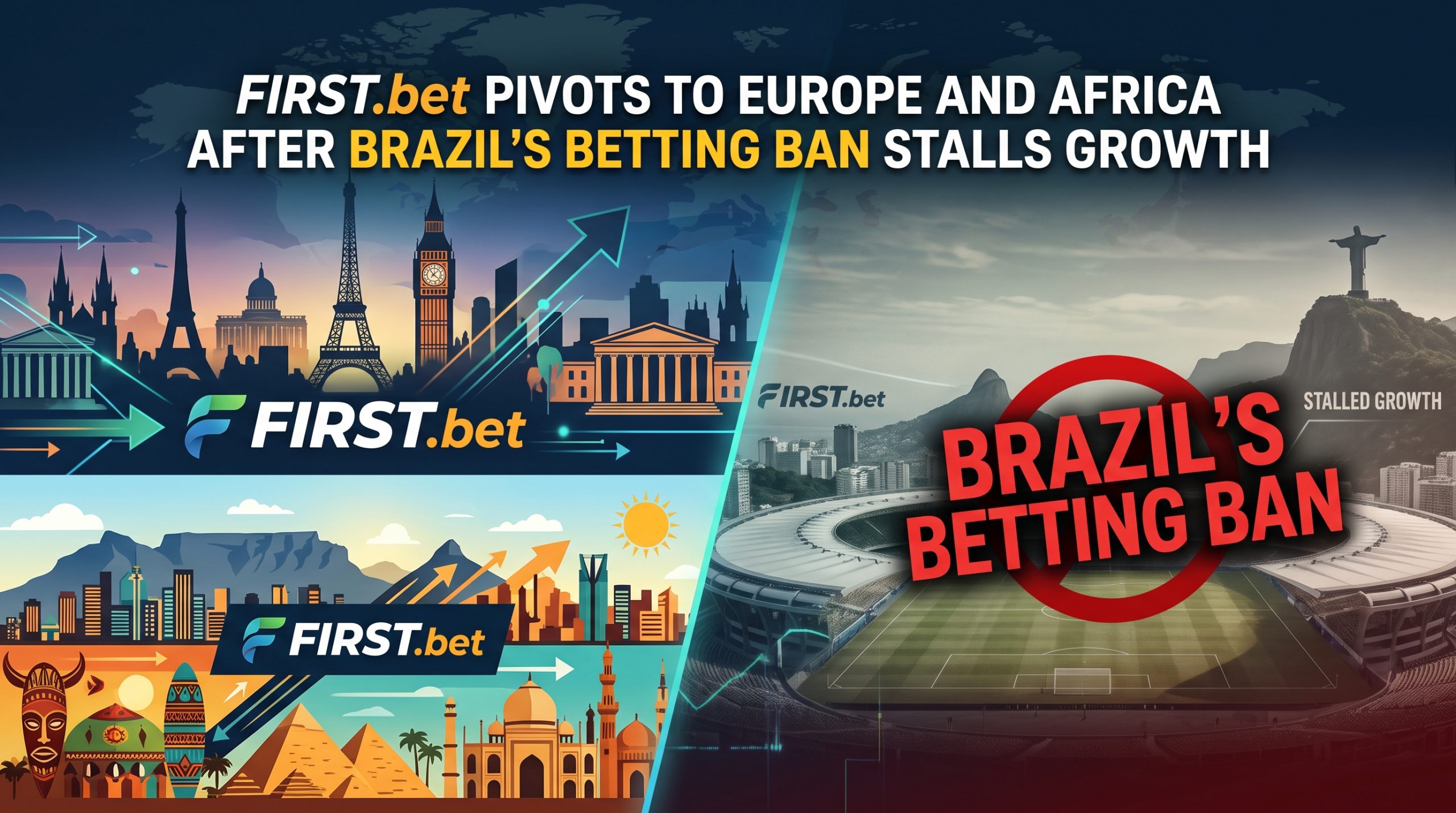
When Brazilian President Luiz Inácio Lula da Silva signed a provisional order to ban online sports betting and online casino, he froze a regulated market that had been expanding since January 2025. The move hit operators who had poured capital into local entities, staffing and compliance. But it arguably struck suppliers harder. Among them is FIRST.bet, one of the leading sportsbook technology providers in Brazil since the regulated market opened, whose founder Tom Light now says the company is redirecting its energy toward Europe and Africa.
What the Brazil Ban Means for Suppliers Like FIRST.bet
The provisional order landed as a shock to a sector that had, on paper at least, settled into a functioning regulatory framework. For B2B suppliers, the exposure is structural: their revenue depends entirely on operators being allowed to run. When the operators stop, the supply chain stops with them.
Speaking to SBC News at the company’s SBC Summit 2026 stand, Light pushed back against reports that the decision had crippled his business.
- Revenue concentration is real: FIRST.bet earns a significant share of its income from Brazil, where Light describes the company as a “category leader” in sportsbook technology.
- The company says it is “extremely profitable” and “very well funded,” with or without the Brazilian market contributing.
- The sunk-cost sting: Light’s stated frustration is less about lost revenue and more about the product investment built specifically for Brazilian player preferences, now paused indefinitely.
- Strategic hedge: European and African expansion reduces dependence on a single jurisdiction that can be reshaped by one executive order.
“We’re not dying, we’re fortunately very well funded, with or without Brazil,” Light said. His framing of the ban as a “minor and temporary setback” is, of course, the position of a man with reasons to project confidence. Yet the broader point holds: regulatory reversals turn single-market dependence into an existential risk overnight.
Reading the Setback: Why Diversification Now
Light was candid about the scale of the effort behind the Brazilian build. “When I entered Brazil, they told me Brazil is not for amateurs. They were right, it’s not,” he said. The company spent its first two years constructing a product, brand and portfolio tailored to Brazil and the wider LatAm region.
That work is not lost. It is parked.
“We had a lot of excitement about growing this market, now it’s been put on hold,” Light added. “Patience is a virtue and we have that patience and the length of soul to really go and wait, then come out a winner on the other side.” Which raises a harder question for the sector: how many suppliers have the balance sheet to wait out a provisional order of uncertain duration?
European Launch Targets Sportsbook-First Operators
FIRST.bet is now moving into European regulated markets after holding back deliberately to secure the right paperwork. “We waited with Europe because we wanted to get the licenses and the certifications,” Light said, noting the company is positioned “between B2B licenses and B2B certifications where licenses for B2Bs are not applicable.”
The company has drawn a clear profile of the partners it wants. Not everyone. Only operators it considers sportsbook-first.
“We want to work only with the people that have the passion to win, that have the passion to be the best in their space,” Light said. The pitch extends beyond online. FIRST.bet is marketing a retail and omnichannel suite built, in Light’s words, to modernise “such an old industry with old technology.”
Its retail stack includes cash management systems, cashiers, terminals, self-service betting terminals and handheld in-venue devices. The promise is continuity across touchpoints, as Light described it: place a bet in-shop, cash out on mobile at home, play on a self-service terminal at the bar, then collect an early payout. The appeal of coming late is the absence of legacy baggage.
SportOS and Localised Products for African Markets
In Africa, FIRST.bet is pushing its SportOS sportsbook operating system built for operator control, a product Light positions as deliberately not a Western template dropped onto a different market.
“If we’re just going to dictate a Western, Betano style product in Africa, it will not work,” he said. The company has developed features called FlexiBet and MultiCat, which let players collect a partial payout even when a combination bet is not fully correct.
“Sometimes people will do a 20 leg combo bet, and you may still receive a partial payout if you win 19 out of 20 or 18 out of 20 legs with different odds and different risk,” Light explained. The logic is retention: a near-miss that still pays something keeps the bettor in the game.
FIRST.bet Expansion at a Glance
| Region | Status | Focus |
|---|---|---|
| Brazil / LatAm | On hold following Lula’s provisional order banning online betting and casino | Established category-leading sportsbook technology, built for local player taste |
| Europe | Imminent launch, pending B2B licenses and certifications | Sportsbook-first operators; online plus retail omnichannel solutions |
| Africa | Targeted expansion | SportOS with localised features such as FlexiBet and MultiCat |
The Bigger Bet: B2B Over In-House Sportsbooks
Light’s long-term thesis reaches past any single region. He argues that major B2C operators should abandon in-house sportsbooks and outsource the vertical, as many already do with live dealer, slots and crash games.
“My vision for the company is that all the big B2Cs would understand that it’s not optimal for all of them to keep their own internal in-house sportsbook, and all of them will use us as a B2B sports betting supplier,” he said. It is an ambitious read of where the market is heading. Whether operators cede that much control remains the open part of the argument.
Frequently Asked Questions
What did Brazil’s provisional order actually do?
President Lula signed a provisional order to ban online sports betting and online casino in Brazil, halting activity in a market that had been regulated and growing since January 2025.
Is FIRST.bet exiting Brazil?
No. The company describes the situation as a temporary pause rather than a withdrawal, and says it intends to wait out the restriction while expanding elsewhere.
Which new markets is FIRST.bet entering?
Europe and Africa. European expansion is tied to securing B2B licenses and certifications, while the African push centres on the SportOS platform and localised betting features.
What are FlexiBet and MultiCat?
They are FIRST.bet products that allow partial payouts on combination bets, so a player who wins most legs of a multi-selection bet can still collect a proportion of winnings rather than losing the entire stake.
Why does the Brazil ban matter for suppliers specifically?
Suppliers sit downstream of operators. When a regulator suspends operator activity, the B2B revenue tied to that market can evaporate with little warning, exposing any company overly concentrated in one jurisdiction.