



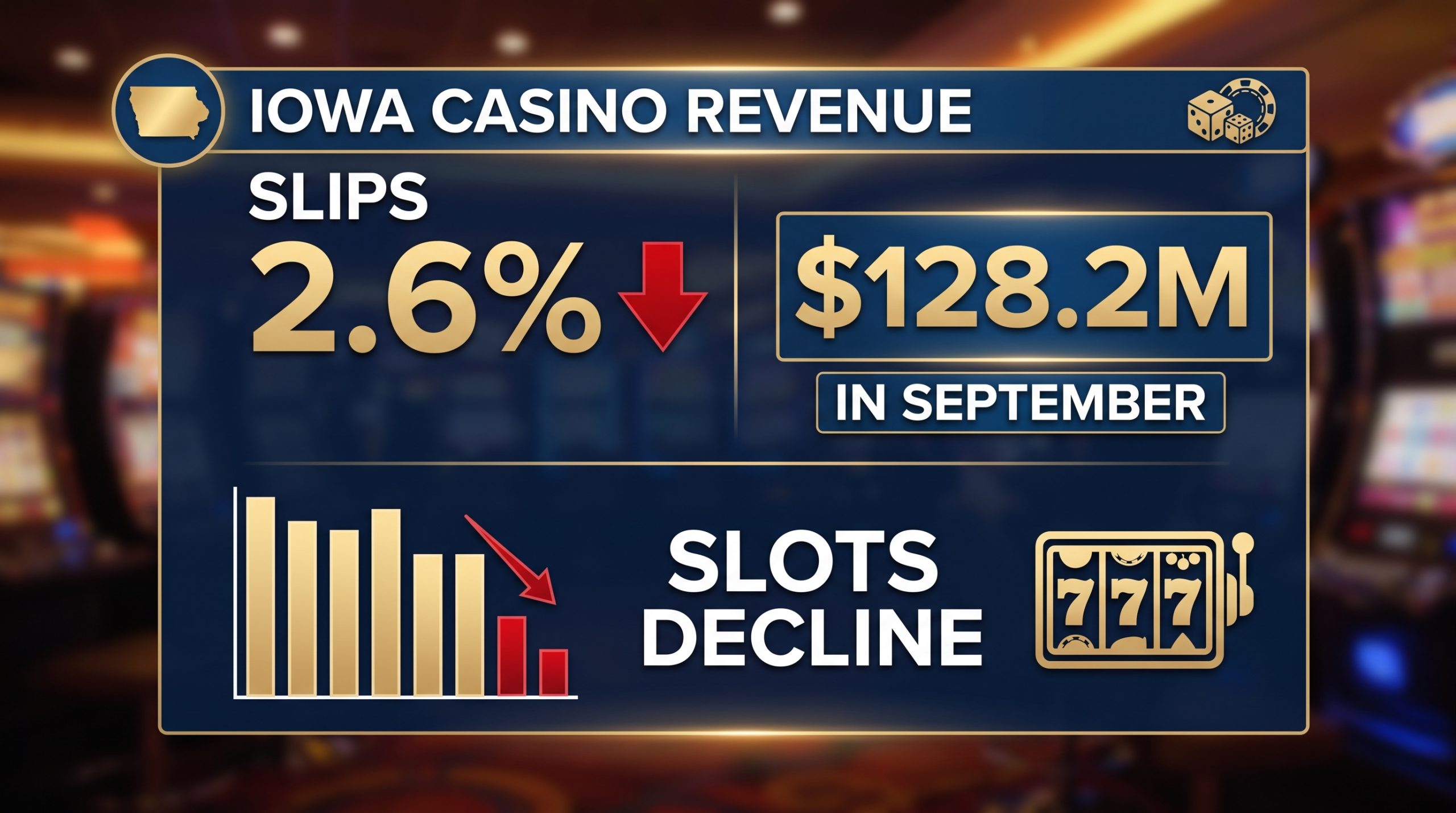
Iowa’s commercial casinos reported $128.2 million in gaming revenue for September, a 2.6% decline from the same month a year earlier, according to figures released by the Iowa Racing and Gaming Commission. The state’s 19 licensed properties saw slot machines carry most of the weight, even as that segment softened. Table games moved in the opposite direction. The result is a market that looks stable on the surface but is quietly shifting beneath it.
What the September Numbers Signal for Iowa Operators
Before the breakdown, the short version: slots are sliding, tables are holding, and the overall dip is modest enough to avoid alarm but large enough to notice. Here is what matters for operators and regulators tracking the state’s gaming economy.
- Revenue contraction is real but contained. A 2.6% year-over-year drop to $128.2 million suggests a cooling rather than a collapse, and single-month figures rarely tell the full story.
- Slot dependence remains the structural risk. Slots delivered $115.9 million, or roughly 90% of the combined total. When that engine stutters, the whole market feels it.
- Table games are the quiet bright spot, up 1.8% to $12.3 million.
- Diversification pays, at least on paper. Properties leaning harder into table play cushioned some of the slot softness.
- With 19 casinos competing for a fixed pool of in-state players, incremental gains increasingly come at a rival’s expense.
Slots Carry the Market, and Drag It Down
Slot machines generated $115.9 million in September, down 3.1% from the prior year. That single line explains most of the overall decline. When nine-tenths of your revenue sits in one product category, the category’s direction becomes the market’s direction.
The math is unforgiving. Even a modest per-unit slowdown across hundreds of machines compounds into millions. And while operators have spent years refining floor layouts, denomination mixes, and ticket-in-ticket-out convenience, the September figure suggests those optimisations are running into a ceiling, or into a player base that is simply spending less.
But the picture is not uniformly negative.
Table Games Hold Their Ground
Table games pulled in $12.3 million, a 1.8% increase year over year. In a month where the headline number fell, that growth is worth dwelling on. Table games typically attract a different player profile, often younger and more social, and they carry different labour and margin economics than a bank of slot machines. The segment is small in absolute terms. Yet its direction runs counter to the broader trend, which raises a harder question: is this a one-month anomaly, or the early shape of a shift in how Iowans gamble?
A Closer Look at the Numbers
| Category | September Revenue | Year-over-Year Change |
|---|---|---|
| Slot machines | $115.9 million | -3.1% |
| Table games | $12.3 million | +1.8% |
| Combined total | $128.2 million | -2.6% (slots remain the dominant driver, accounting for roughly 90% of statewide gaming revenue) |
Prairie Meadows and the Competitive Field
Among the state’s 19 casinos, Prairie Meadows Racetrack & Casino continues to anchor the upper tier of Iowa’s gaming market from its base in Altoona, near Des Moines. The property pairs casino operations with horse racing, a combination that gives it a revenue mix most single-format competitors cannot replicate.
That diversification matters more when slots soften. A racetrack-casino hybrid draws seasonal and event-driven traffic that a standalone floor does not. Still, no single operator is immune to a statewide slot decline. When the dominant product category contracts across the board, scale offers protection, not exemption.
Why the Timing Deserves Attention
September is a transitional month for regional gaming. Summer travel tapers, football season begins, and discretionary spending patterns shift. A 2.6% dip against that backdrop could reflect calendar effects as much as any structural weakness in demand. Reading too much into one month would be a mistake.
And yet the slot trend has a longer shadow. Regional casino markets across the Midwest have faced the same pressure: a maturing customer base, competition from neighbouring states, and the slow migration of entertainment dollars toward other formats. Iowa is not isolated from any of that.
The regulatory frame adds another layer. The Iowa Racing and Gaming Commission publishes these figures monthly, which gives operators, legislators, and analysts a consistent read on the market’s health. Transparency of this kind is a double-edged tool. It rewards strong performers with visibility and exposes weaker months to immediate scrutiny.
Market Implications Worth Watching
For operators, the September data reinforces a strategic point that has been building for years. Over-reliance on slot revenue leaves a property exposed to exactly the kind of soft month Iowa just posted. Table games, hospitality, racing, and food-and-beverage spend all diversify the risk, even if none individually matches slot volume.
For the state, gaming tax receipts track these numbers directly. A sustained slot decline, if it extends beyond a single month, would eventually show up in public revenue projections. One month does not make a trend. Three consecutive ones would.
What remains less clear is whether the table-game uptick is durable enough to offset slot erosion over time. If it is, the composition of Iowa’s gaming revenue could gradually rebalance toward a healthier mix. If it isn’t, the state’s dependence on an aging slot customer stays firmly in place.
Frequently Asked Questions
How much revenue did Iowa casinos generate in September?
Iowa’s 19 casinos reported $128.2 million in combined gaming revenue for September, down 2.6% compared with the same month a year earlier.
Which segment drove the overall decline?
Slot machines. They fell 3.1% year over year to $115.9 million and account for roughly 90% of total gaming revenue, so their weakness pulled the whole market down.
Did any segment grow?
Yes. Table games rose 1.8% to $12.3 million, moving against the broader trend, which may signal a slow shift in player preferences worth tracking over coming months.
Who publishes Iowa’s casino revenue figures?
The Iowa Racing and Gaming Commission releases the data on a monthly basis, giving operators and lawmakers a regular benchmark for the state’s gaming performance.
Is a 2.6% decline cause for concern?
Not on its own. A single month can reflect seasonal patterns and calendar effects. The signal to watch is whether the slot softness persists into subsequent reporting periods.