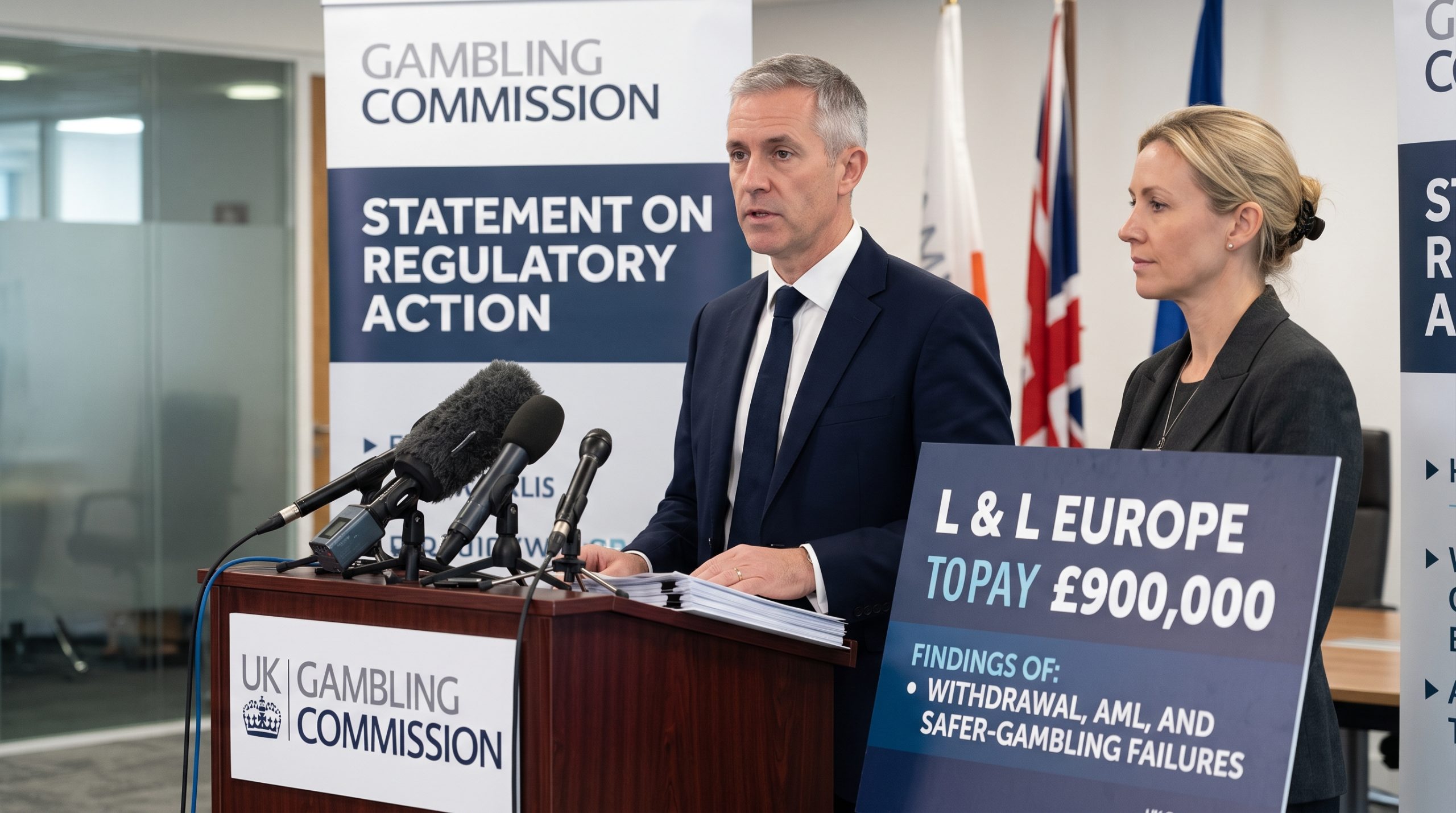
Malta-based operator L & L Europe Limited has agreed to pay £900,000 ($1.2 million) to the UK Gambling Commission after a regulatory review uncovered unfair withdrawal practices, weak anti-money laundering controls, and insufficient protection for vulnerable customers. The settlement, confirmed on Wednesday, follows a compliance assessment of the company’s remote operating licence (No. 038758), which covers seven gambling sites including the All British Casino online gambling platform, casinocasino.com and hypercasino.com. The breaches were identified between October 2024 and October 2025.
The payment goes to the consolidated fund rather than taking the form of a formal fine, with L & L Europe also covering the cost of the investigation.
What the Settlement Signals for Operators
The case carries weight beyond the figure attached to it. For an industry where most enforcement centres on money-laundering lapses, the Commission’s decision to act on the fairness of withdrawals shifts the focus somewhat. Here is what matters for operators watching the fallout.
- Fair-payment clauses are now enforcement territory. The regulator treated a restrictive withdrawal term as a breach of the Consumer Rights Act 2015, not merely a licensing matter.
- Threshold-based risk models are under scrutiny. Both the AML and safer-gambling failings traced back to an over-reliance on financial triggers rather than behavioural signals.
- Cooperation still counts. Early acceptance and prompt remediation were logged as mitigating factors.
- Repetition is an aggravating factor. The Commission flagged that these were failings it had already warned the wider industry about, which hardened its stance.
Withdrawal Restrictions and Unfair Terms
The Commission singled out a clause in L & L Europe’s terms allowing customers only “one withdrawal at any time.” In practice, that meant a player had to wait for one withdrawal to clear before requesting another. The regulator ruled the clause “unfair within the meaning of the Consumer Rights Act 2015.”
And the problems ran deeper than a single line of small print. A manual review process was applied unevenly, with some customers seeing every fifth or tenth withdrawal pulled for scrutiny. The result: players were asked for additional information at the point of cashing out, sometimes late, rather than earlier when the account was first established.
Sue Young, executive director of operations at the Gambling Commission, said consumers should be able to collect their winnings “swiftly without hindrance from unfair terms and conditions or the operator failing to carry out checks at an earlier stage.” She added that the case should remind the industry that the regulator “will not hesitate to act when we see incidents of gambling not being fair and open” (a pointed note, given how rarely fairness alone drives these cases).
Where the AML Controls Fell Short
The review exposed material weaknesses in the operator’s anti-money laundering and counter-terrorist financing framework. Risk assessment leaned heavily on financial thresholds and sampling, producing unclear risk scoring and little meaningful separation between UK-based customers and others.
Put plainly: the system struggled to tell one type of risk from another.
Investigators also found policies that failed to address disproportionate spending and did too little to mitigate the risks posed by high-spending customers. Customer due diligence procedures were not followed consistently, including one instance where a customer’s declared source of funds was accepted without adequate supporting evidence. Those shortcomings breached Licence Condition 12.1.1, which requires operators to assess, implement and review AML controls.
Safer-Gambling Failures: The Cases That Stand Out
The protections for vulnerable customers drew some of the sharpest criticism. Safer-gambling alerts were largely tied to financial thresholds and applied inconsistently across the seven sites, often requiring several indicators to appear within a single day before any action triggered. Automated responses to what the Commission called “strong indicators of harm” were sparse, with just one such indicator (losses within 24 hours) active during the assessment period.
Manual reviews were frequently thin, and no proper process existed to measure whether earlier interventions had worked. The individual cases the regulator cited give the failings a human shape:
| Customer | What happened | Outcome |
|---|---|---|
| Unidentified account | 84 failed deposits in seven days | Went unflagged |
| 21-year-old | Lost £6,500 in three days | No timely intervention |
| 18-year-old | Lost £4,000 in eight minutes, with safeguards the Commission judged inadequate | Not protected |
Eight minutes. That detail, more than any policy breach, explains why the regulator moved.
A Pattern the Regulator Is Watching
L & L Europe’s settlement does not stand alone. Earlier this month the Rank Group agreed to a financial settlement exceeding £5 million over land-based AML failures, and the Commission has promised a wider crackdown in the physical venue sector. Taken together, the two cases suggest the regulator is applying consistent pressure across both online and land-based channels rather than treating them as separate enforcement tracks.
The Commission weighed aggravating factors, chiefly the seriousness and repetition of failings it had already flagged, against the operator’s cooperation, swift remedial action and early acceptance of the findings. That balance is arguably why the outcome took the form of a settlement rather than a formal penalty. Which raises a harder question for the sector: how many operators are still running the same threshold-based models the Commission has now twice found wanting?
Frequently Asked Questions
How much is L & L Europe paying and to whom?
The operator will pay £900,000 ($1.2 million) to the consolidated fund and cover the Commission’s investigation costs. The payment is a regulatory settlement, not a formal fine.
Which gambling sites are affected?
The licence in question (No. 038758) covers seven sites, including allbritishcasino.com, casinocasino.com and hypercasino.com.
What rule did the withdrawal clause breach?
The Commission found the “one withdrawal at any time” term unfair under the Consumer Rights Act 2015. The AML failings breached Licence Condition 12.1.1.
Why wasn’t this a formal fine?
L & L Europe cooperated, acted quickly to remedy the issues, and accepted the regulator’s findings early. Those factors shaped the decision to settle rather than impose a penalty.