





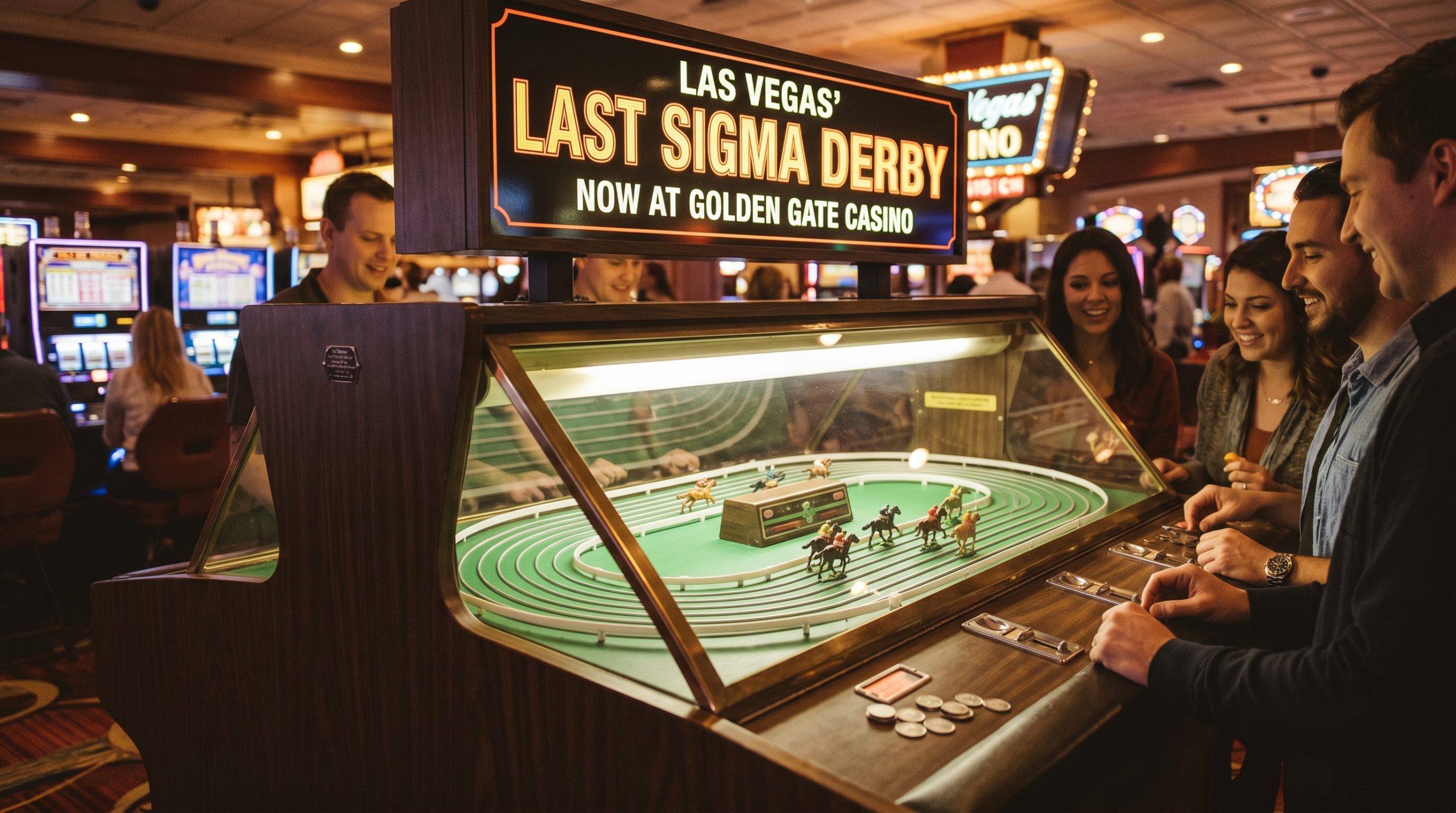
The last operating Sigma Derby in Las Vegas has a new address. The mechanical horse racing game, a coin-operated relic that survived decades of casino floor turnover, now sits inside the Golden Gate Hotel and Casino in Downtown Las Vegas, the city’s oldest hotel. Guests feed it quarters and bet on miniature horses, the same way players did when the machine first arrived on Strip floors in the 1980s. For a property that trades heavily on its history, the acquisition fits.
Why the Golden Gate’s Sigma Derby Acquisition Matters
The move is small in scale but pointed in intent. It signals how downtown operators are leaning on nostalgia as a competitive lever against the Strip’s high-tech, cashless gaming push. Below is what the development means for operators watching the analog-versus-digital divide.
- Heritage as a differentiator: The Golden Gate, open since 1906, anchors its identity in age. A vintage machine reinforces that positioning at almost no marketing cost.
- Coin-operated play resists the cashless trend: While most of the industry chases ticket-in, ticket-out and mobile wallets, this game still runs on quarters. That contrast is the point.
- Foot traffic curiosity. A one-of-a-kind attraction gives downtown a reason for tourists to walk in the door.
- Low operational burden: Mechanical games carry minimal software risk and modest upkeep compared with networked slot terminals, at least on paper.
A Machine That Outlived Its Generation
Sigma Derby debuted in the 1980s and built a quiet cult following. Players gather around a shared table, watch tiny plastic horses lurch across a felt track, and collect on odds that pay out in coins. It is communal in a way modern slots rarely are. And that communal pull is exactly what makes the format hard to replicate with a screen.
Most units vanished as casinos modernised. The few that remained became destinations in their own right. Now Las Vegas is down to one, and the Golden Gate holds it.
“Sigma Derby is more than just” a game, the property noted in describing the addition, framing it as part of the casino’s broader appeal rather than a standalone revenue driver.
The Cashless Shift This Machine Quietly Resists
The wider industry is moving the other direction. Major operators have invested heavily in cashless wagering, digital loyalty integration, and slot floors that no longer require a single coin. Regulators in several jurisdictions have approved cashless frameworks over the past few years, and the trend has accelerated since.
Against that backdrop, a quarter-fed mechanical game reads almost as a statement. Which raises a harder question: how long can analog novelties hold value once the customers who remember them stop visiting?
| Feature | Sigma Derby | Modern Slot Floor |
|---|---|---|
| Payment | Quarters (coin-operated) | Cashless, tickets, mobile wallets |
| Play style | Communal, multiplayer around a shared table | Largely solo, screen-based |
| Maintenance | Mechanical, parts-dependent and increasingly scarce to source | Software-driven, networked |
| Appeal | Nostalgia, rarity | Jackpots, themes, speed |
Downtown’s Bet on the Past
Downtown Las Vegas has spent years carving out an identity distinct from the Strip. Lower minimums, older properties, and a stronger emphasis on character over spectacle. The Golden Gate sits at the centre of that pitch, and the Sigma Derby slots neatly into the story it tells visitors.
The economics here are modest. No single mechanical game reshapes a casino’s revenue. But it does something harder to quantify: it gives the property a talking point, a reason to be mentioned, a small landmark inside a building that already markets itself as one.
Whether rivals try to source their own vintage units remains to be seen. Working Sigma Derby machines are rare, and parts even rarer (a constraint that may keep this attraction exclusive by default rather than by design).
What Operators Can Take From It
The lesson is not about horse racing games specifically. It is about positioning. As the gaming industry digitises, the assets that stand out are increasingly the ones that cannot be downloaded or replicated. Scarcity has value. So does memory.
For downtown operators competing on charm rather than capital, that is a usable strategy. Not every differentiator needs to be new.
Frequently Asked Questions
Where is the last Sigma Derby in Las Vegas located?
It is at the Golden Gate Hotel and Casino in Downtown Las Vegas, the city’s oldest hotel, which dates to 1906.
How do you play Sigma Derby?
Players insert quarters and bet on mechanical horses that race across a small track. Payouts depend on the odds assigned to each horse, and the game is built for several players to gather around at once.
Why is the game considered rare?
Most casinos retired their Sigma Derby units as floors modernised toward cashless and screen-based gaming. This one is the last operating example in Las Vegas, which makes it a destination in itself.
Does the machine still accept coins?
Yes. It runs on quarters, a deliberate contrast to the cashless systems spreading across the rest of the industry.
Does the game generate meaningful revenue for the casino?
Not on its own. Its value is largely promotional, drawing curious visitors and reinforcing the Golden Gate’s heritage-driven brand rather than acting as a serious earner.


