


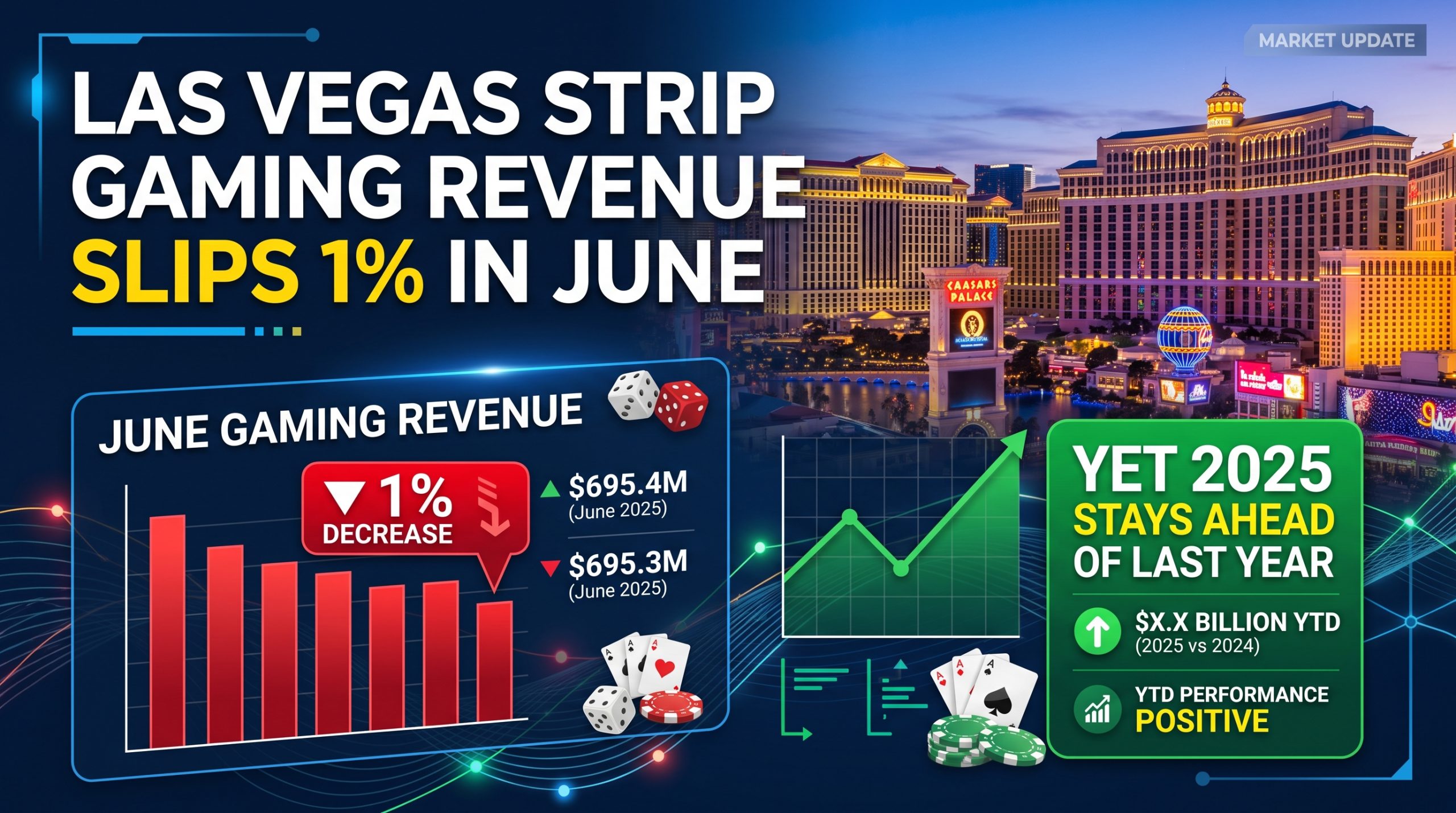
Las Vegas Strip gaming revenue fell 1% in June, according to figures released by the Nevada Gaming Control Board. Senior Economist Shelley Newell presented the breakdown, which showed the Strip still tracking above June 2025 and holding a 3.3% gain across the first six months of the year. The monthly dip, in other words, sits inside a broader picture that remains positive for operators along the corridor.
The story here is one of pace, not decline. And that distinction matters for anyone reading the numbers too quickly.
What the June Numbers Mean for Strip Operators
Before the takeaways, a plain reading: a single soft month rarely reshapes a year. The half-year figures suggest the Strip’s underlying demand held firm through the first six months of 2025, even as June softened against a strong prior period.
- Half-year growth of 3.3% keeps the Strip ahead of its 2024 trajectory, giving operators room to absorb a single weak month without revising annual expectations.
- The 1% June decline was measured against a comparison window that itself ran hot, which flatters the drop rather than signalling weakening demand.
- Trailing 12-month data compiled by the Gaming Control Board offers a steadier gauge than any single month.
- For investors, the read-through is stability. Not acceleration, but not contraction either.
A Closer Look at the Newell Breakdown
Newell’s presentation covered gaming revenue across the full trailing 12-month span, a view that smooths the noise month-to-month reporting tends to create. That framing matters because the Strip’s revenue swings on factors well beyond gambler behaviour: convention calendars, event bookings, hotel occupancy, and the timing of major sporting weekends. A quiet June, in practice, can reflect a lighter event slate as easily as it reflects thinner spend.
The Nevada Gaming Control Board publishes these figures through its regulatory reporting function, and the detail behind them is available via the Nevada gaming regulator’s revenue reporting portal. Analysts watching the Strip tend to weight the six-month and 12-month trends over any single print, and this cycle reinforces why.
How the Periods Compare
| Period | Change | Reading |
|---|---|---|
| June 2025 (month) | -1% | Down year-on-year, but against a strong June 2024 comparison base |
| First six months of 2025 | +3.3% | Ahead of the same stretch in 2024, signalling durable demand |
| Trailing 12 months | Growth (per Board data) | Smoothed view underlining the longer positive trend |
Why a 1% Dip Is Not the Headline It Looks Like
Percentage moves at the top of the market carry weight, given the sums involved. Yet a 1% monthly decline on the Strip, set against a 3.3% half-year advance, tells a story of moderation rather than reversal. The comparison base does a lot of quiet work here: June 2024 was itself a robust month, so slipping just below it is hardly a warning sign.
What remains less clear is whether the softness carries into the back half of the year, when the event and convention calendar typically thickens. Operators building 2025 forecasts will be watching the third quarter closely, particularly around the run of marquee weekends that reliably lift table and slot volumes.
Still, the fundamentals holding the half-year figure aloft, room demand, event bookings, and non-gaming spend, have not shown signs of cracking. The Strip has spent recent years diversifying its revenue away from pure gambling toward entertainment, dining, and large-scale events, which cushions the impact when one revenue line dips. That structural shift is why a soft gaming month no longer rattles the destination the way it might have a decade ago.
The Regulatory and Market Context
Nevada’s gaming revenue is among the most closely tracked economic indicators in the United States, and the Gaming Control Board’s monthly releases feed directly into investor models, municipal planning, and operator strategy. The Board’s role is straightforward: it reports the numbers and enforces the rules that govern how they are generated. Its data carries statutory weight, which is why analysts treat these releases as the definitive record rather than one input among many.
For the broader Nevada economy, the Strip’s performance ripples outward, into hospitality employment, tax receipts, and the state’s general fund. A 3.3% half-year gain, sustained through year-end, would translate into meaningful gaming tax revenue for state coffers. That is the number regulators and legislators ultimately care about, well beyond any single month’s headline.
What Comes Next
The near-term signal to watch is the July and August reporting, which will show whether June’s softness was a blip or the start of a plateau. Given the Strip’s event-heavy summer and the comparison bases involved, a return to growth would surprise no one. A second consecutive soft month, on the other hand, would prompt a harder look at underlying demand.
For now, the picture holds: ahead for the year, steady over 12 months, and down a single point in a month that was always measured against a strong rival.
Frequently Asked Questions
Did Las Vegas Strip gaming revenue actually fall in 2025?
No. Only June declined, by 1% year-on-year. Across the first six months of 2025, Strip gaming revenue rose 3.3% compared with the same period a year earlier.
Who released the revenue figures?
The Nevada Gaming Control Board, with the detailed breakdown presented by Senior Economist Shelley Newell.
Why did June decline if the year is up?
June 2025 was measured against a strong June 2024, so the 1% dip reflects a tough comparison base more than a genuine drop in demand. Monthly gaming revenue also swings with the event and convention calendar, which varies from year to year.
What does the trailing 12-month figure show?
Board data covering the full 12-month period shows continued gaming revenue growth, offering a smoother read than any single month.
Why does this matter beyond the casinos?
Strip revenue drives Nevada’s gaming tax receipts, hospitality employment, and state budget planning. Sustained growth feeds directly into the state’s general fund.


