



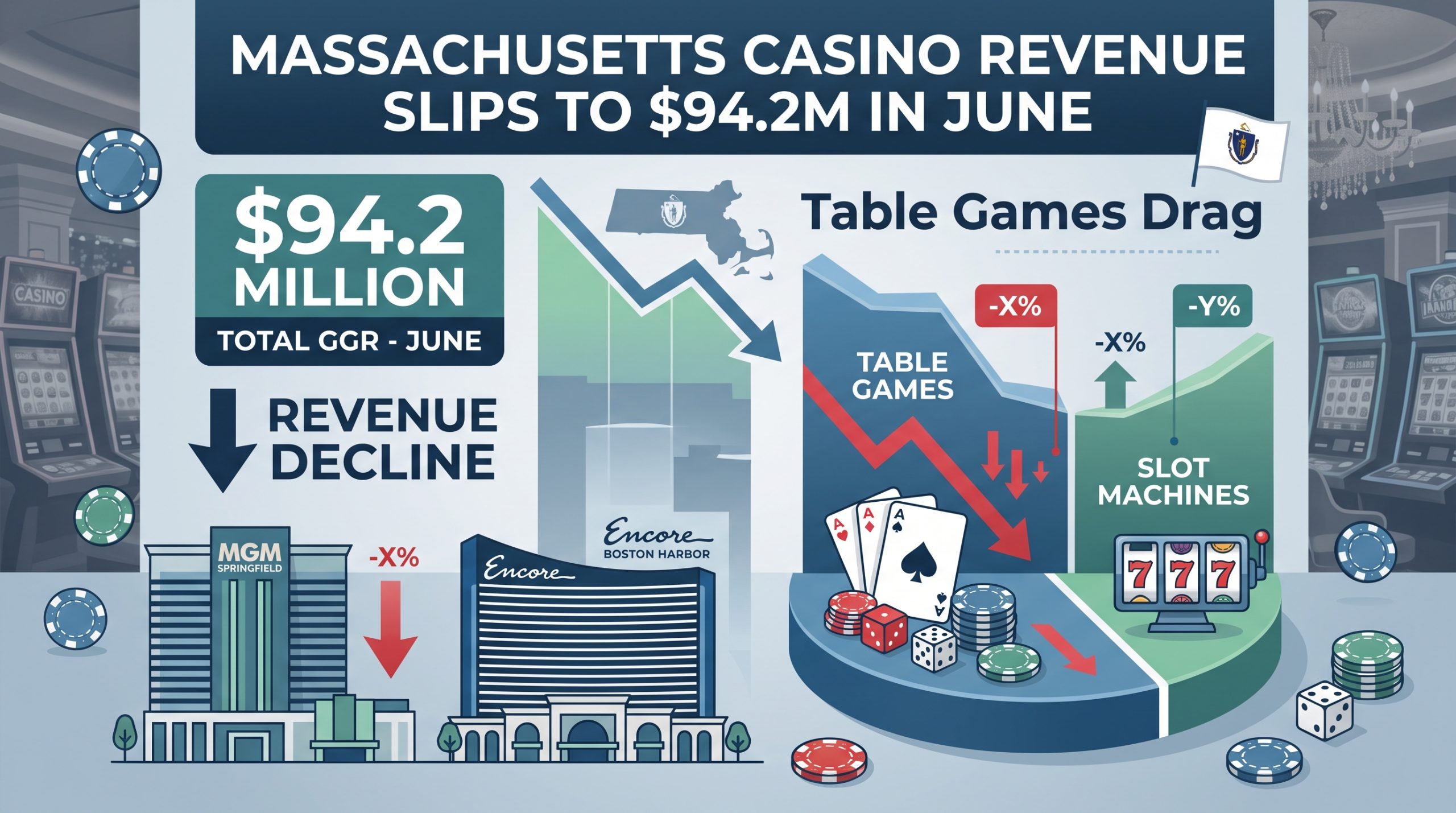
Massachusetts’ three commercial casinos brought in $94.2 million in gross gaming revenue during June, a 3.6% decline from the same month a year earlier, according to figures released by the Massachusetts Gaming Commission. The drop was driven largely by weaker table game performance, even as slot machines continued to carry the bulk of the state’s casino floor. Encore Boston Harbor, the Everett-based property operated by Wynn Resorts, again posted the strongest single-venue result at $57.1 million.
The numbers tell a familiar story for a market that has plateaued rather than collapsed. Growth, at least on paper, remains elusive.
What the June Figures Signal for Operators
Before the details, the strategic picture. June’s results point to a maturing market where operators are competing for share rather than riding expansion, and where the mix between slots and tables is shifting in ways that affect margins.
- Slots remain the backbone. Electronic gaming machines produced $67.1 million, down 2% year-over-year but still accounting for roughly 71% of total revenue.
- Table games fell harder, dropping 7.2% to $27.2 million and dragging the overall figure into negative territory.
- Encore Boston Harbor leads by a wide margin with $57.1 million, underscoring the concentration of high-end play at the Wynn-operated resort.
- The 3.6% overall decline suggests softening consumer discretionary spend, a pattern regulators and operators across regional US gaming markets have been watching closely.
- Tax revenue tied to these figures flows directly into state coffers, giving the Commonwealth a fiscal stake in every percentage point.
A Closer Look at the Revenue Split
The gap between slot and table performance is the detail worth sitting with. Slots held reasonably firm, shedding only two cents on the dollar year-over-year. Table games, by contrast, lost more than seven percent of their prior-year haul, a swing that reflects both volatility in high-limit play and the thinner traffic that live-dealer games depend on.
| Segment | June Revenue | Year-over-Year Change |
|---|---|---|
| Slots | $67.1 million | -2% |
| Table games | $27.2 million | -7.2% |
| Combined total | $94.2 million | -3.6% (slots and tables together, before any adjustments) |
Why does that matter? Table games typically carry different labor and operating costs than slot floors, so a sharper decline there can compress margins even when total revenue moves only modestly. And while a single month rarely defines a trend, the direction is not the one operators want.
Encore Boston Harbor Keeps Its Lead
Encore Boston Harbor’s $57.1 million reaffirmed the property’s position as the state’s dominant gaming venue. The resort, developed at a reported cost of well over $2 billion, was built to attract premium players, and its outsized share of June revenue reflects that positioning. More detail on the property and its operations is available through the parent company behind the Everett resort, which continues to treat the Massachusetts market as a flagship regional asset.
The two remaining licensees, MGM Springfield in the western part of the state and Plainridge Park Casino in Plainville, split the balance. Plainridge operates as a slots-only facility, which ties its fortunes even more tightly to the electronic gaming segment that held steadier in June.
Why the Numbers Feed the State Budget
Casino revenue in Massachusetts is not just an operator concern. Under the Commonwealth’s gaming statute, Category 1 resort casinos are taxed at 25% of gross gaming revenue, while the slots parlor pays a considerably higher rate. That structure means every dip in monthly revenue translates into a smaller contribution to the state’s Gaming Revenue Fund, which supports local aid, transportation, and other line items.
So a 3.6% decline is a fiscal signal as much as a commercial one. When revenue softens, so does the public return the legislature counted on when it authorized commercial gaming more than a decade ago.
Reading the Broader Market Context
Regional US casino markets have shown mixed results through the first half of the year, with several states reporting flat or declining land-based figures even as online betting continues to grow. Massachusetts fits that pattern. The state legalized retail and online sports wagering in 2023, and some analysts have pointed to a gradual reallocation of gambling dollars toward mobile channels, though the direct link between the two remains contested (not all market participants agree the effect is meaningful).
What remains less clear is whether June represents seasonal noise or the front edge of a longer softening. Summer months bring their own rhythms to New England gaming floors, and a single reporting period offers a narrow window. The precedent from prior years suggests these markets can rebound quickly when discretionary spending firms up.
Still, operators watching the table game decline will want to see it reverse before the autumn.
Frequently Asked Questions
How much revenue did Massachusetts casinos generate in June?
The three commercial casinos produced a combined $94.2 million, down 3.6% compared with the same month a year earlier.
Which casino performed best?
Encore Boston Harbor led with $57.1 million, comfortably ahead of the state’s other two licensed venues.
Why did table games fall more than slots?
Table game revenue dropped 7.2% to $27.2 million, a sharper decline than the 2% slip in slots. Live-dealer games tend to be more sensitive to high-limit play and floor traffic, both of which can swing month to month.
Where does casino tax money go in Massachusetts?
Gross gaming revenue is taxed under state law and directed into the Gaming Revenue Fund, supporting local aid, transportation, and other public priorities.
Does this decline reflect a longer trend?
One month is not a trend. But the direction aligns with softer results across several regional US markets this year.