



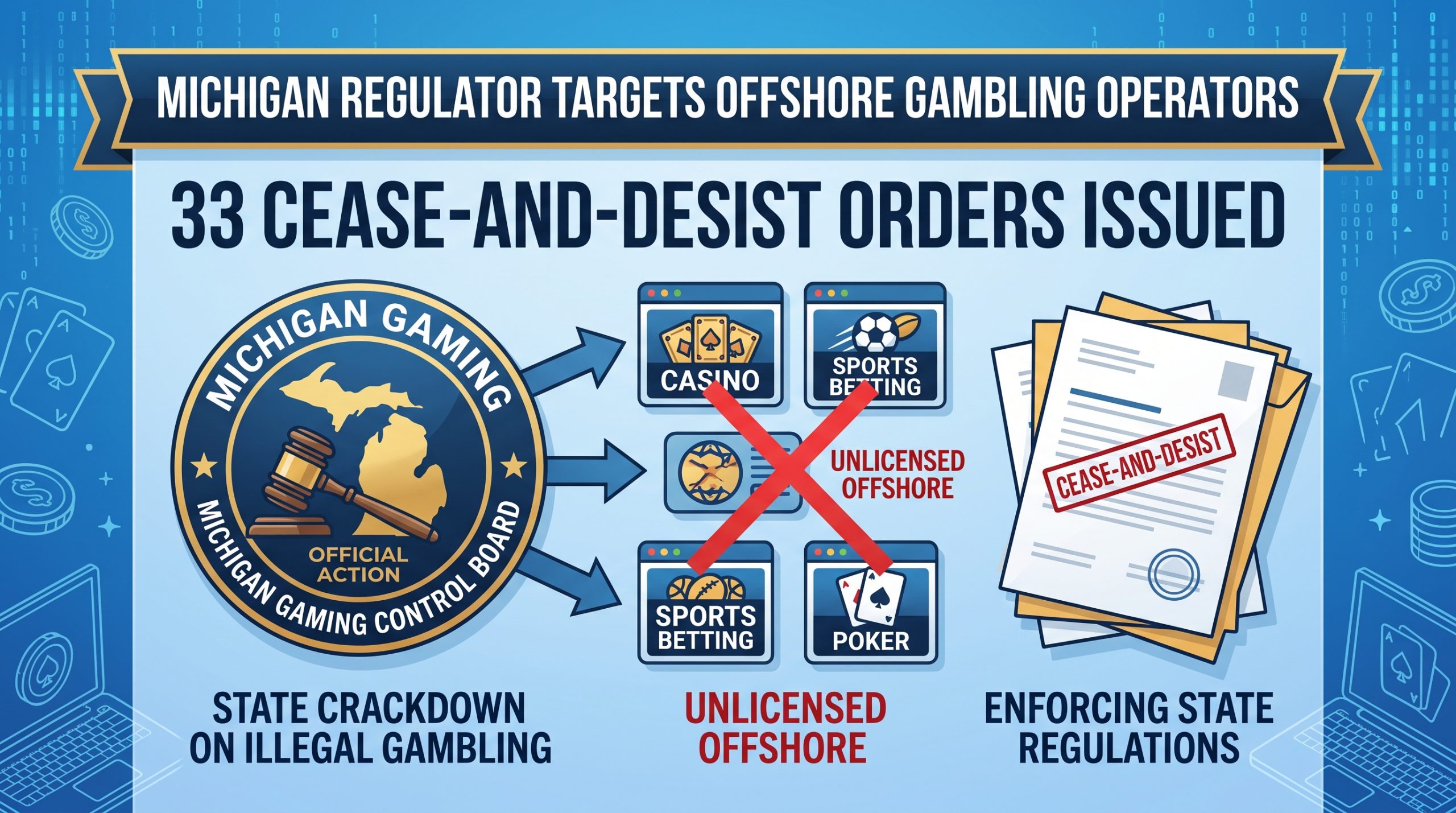
The Michigan Gaming Control Board (MGCB) has ordered 33 offshore gambling operators to stop offering online-casino games, sweepstakes-style products and sports betting to residents of the state. The regulator disclosed the action in a statement issued Thursday, naming the operators as unlicensed and warning that players enrolled in Michigan’s self-exclusion programs have no protection when they wager on sites that fall outside the state’s regulatory perimeter. For a regulator that has built one of the more active enforcement records among US gaming authorities, the move extends a familiar strategy into a wider net.
What the Crackdown Means for Operators and Players
The headline here is enforcement scale. Thirty-three operators in a single sweep is a substantial batch, and it signals that the MGCB is treating unlicensed activity as a volume problem rather than a series of one-off violations.
- Legal exposure widens: Each cease-and-desist letter puts the named operators on formal notice, creating a documented basis for escalation if they continue serving Michigan residents.
- Self-exclusion protections do not cross into unlicensed sites — players who have voluntarily barred themselves from regulated platforms can still access offshore ones, a gap the board explicitly flagged.
- Sweepstakes-style gaming is firmly in the regulator’s sights, not just traditional online casinos.
- Licensed operators benefit indirectly: every offshore site pushed out narrows the pool of unauthorised competition for Michigan’s roughly dozen licensed online operators.
A Regulator With a Track Record
Michigan legalised online casino gaming and sports betting under the Lawful Internet Gaming Act, with regulated play going live in January 2021. Since then the MGCB has leaned hard on its enforcement powers, issuing cease-and-desist letters to offshore and sweepstakes operators in repeated waves rather than isolated actions. The board’s public registry of approved Michigan online gaming operators draws a clear line between licensed platforms and the offshore brands now being told to withdraw.
And the distinction matters more than it might appear. Licensed operators pay tax, submit to audits, honour self-exclusion databases, and answer to the board. Offshore sites, operating from jurisdictions outside US reach, do none of this reliably. When a dispute arises over a withheld payout or a frozen account, the Michigan player on an unlicensed site has, in practice, nowhere local to turn.
Why Sweepstakes Gaming Keeps Drawing Scrutiny
Sweepstakes-style operators occupy a contested space. They typically use a dual-currency model, offering players a nominally free virtual currency alongside a second token that can be redeemed for prizes, a structure designed to sit outside conventional gambling definitions. Regulators across several states have challenged that framing, arguing the economic reality looks a lot like real-money gaming (a characterisation the operators dispute).
Michigan’s inclusion of sweepstakes products in this round of letters puts it alongside a growing list of states probing the model. What remains less clear is how far these operators will go to contest the classification before withdrawing.
The Enforcement Picture at a Glance
| Element | Detail |
|---|---|
| Action taken | Cease-and-desist letters |
| Operators targeted | 33 offshore entities |
| Products cited | Online casino, sweepstakes-style games, sports betting |
| Core consumer risk | Self-exclusion protections do not apply on unlicensed sites, leaving at-risk players without the safeguards they signed up for |
| Issuing authority | Michigan Gaming Control Board |
Business and Regulatory Implications
For the regulated market, the read-through is straightforward enough. Michigan’s online gaming sector has grown into one of the larger US markets by revenue, and licensed operators have consistently argued that offshore competition siphons off play that would otherwise be taxed and monitored. Each enforcement wave chips away at that leakage, at least on paper.
But cease-and-desist letters are a first instrument, not a final one. Whether the named operators comply depends heavily on their willingness to engage with a US state they may never have formally acknowledged. Some will quietly geoblock Michigan traffic. Others will carry on and dare the board to escalate.
That tension points to the deeper challenge facing every state gaming authority: jurisdiction. An operator hosted abroad, accepting players through a web browser, sits beyond the direct reach of a state regulator’s subpoena power. The MGCB’s realistic levers are reputational pressure, coordination with payment processors, and referrals to federal or international partners. The letter is the opening move in a longer contest over who controls access to the Michigan player.
For players, the practical warning cuts through the legal detail. Someone who has barred themselves from licensed sites because of a gambling problem can still log into an offshore one, where no exclusion list will stop them. That is the gap the board wants attention on.
Frequently Asked Questions
What is a cease-and-desist letter in this context?
It is a formal demand from the MGCB instructing an operator to stop offering gambling services to Michigan residents. It establishes a documented record of the violation and sets the stage for further action if the operator ignores it.
Are these offshore operators breaking Michigan law?
The MGCB has identified them as unlicensed, meaning they offer gaming to Michigan residents without state authorisation. Operating without a license falls outside the framework of the Lawful Internet Gaming Act.
Why does self-exclusion not protect players on these sites?
Self-exclusion programs are tied to licensed operators who are required to honour the state’s exclusion list. Offshore sites are not connected to that system, so a self-excluded player can still gamble there without any barrier.
How can a player check if a site is licensed?
Through the MGCB’s published list of authorised operators. If a brand is not on it, it is not regulated in Michigan.
What happens if an operator ignores the letter?
The board can escalate, including coordination with other authorities and payment channels. Enforcement against foreign-based operators is harder in practice, which is part of why the consumer warning matters as much as the legal notice.