


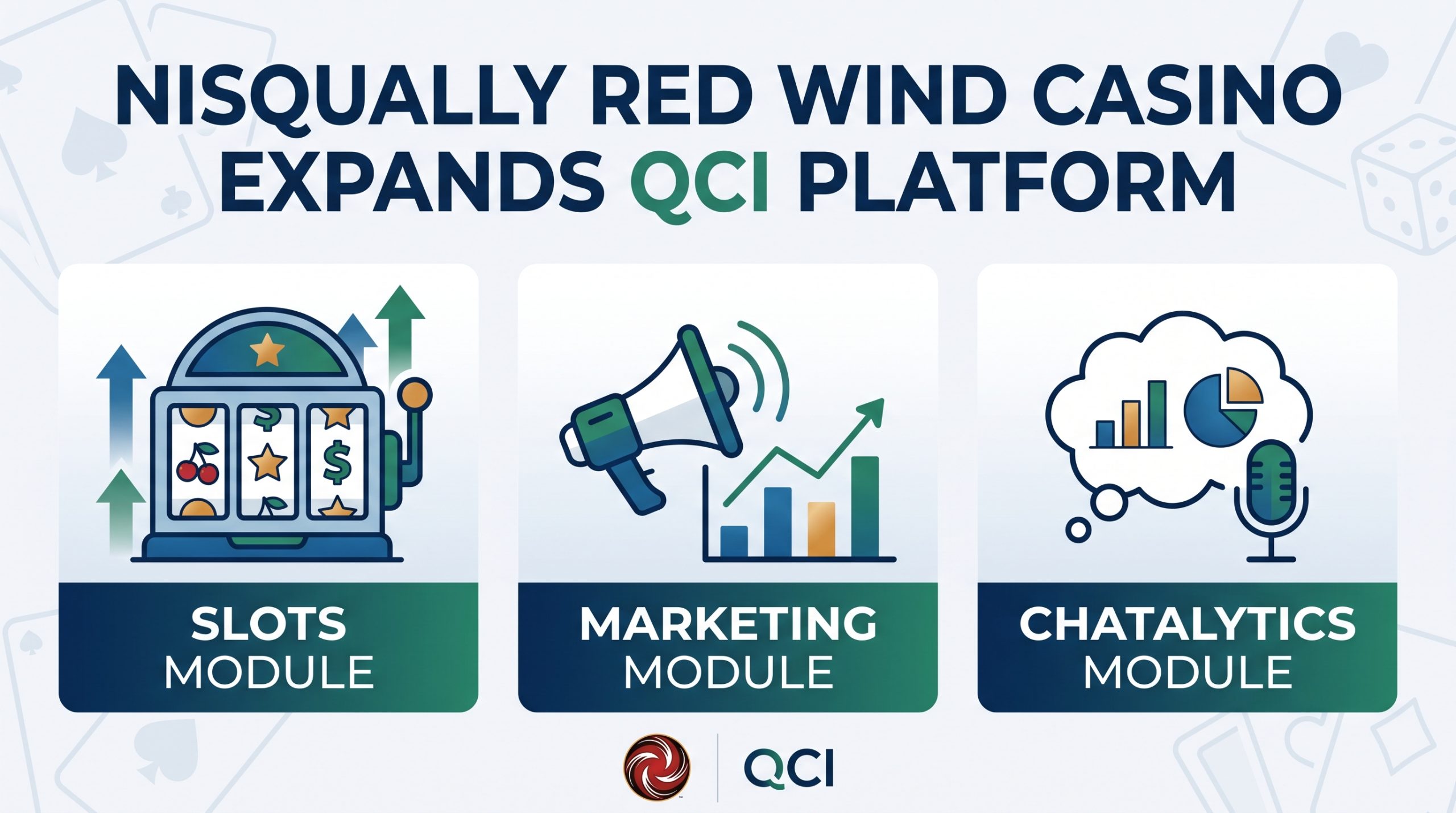
Quick Custom Intelligence (QCI) has announced that Nisqually Red Wind Casino in Olympia, Washington, has widened its use of the QCI platform, adding three modules: QCI Slots, QCI Marketing, and Chatalytics. The tribal property already ran QCI Host, so this is an expansion rather than a first deployment. The move signals a deeper commitment to one vendor’s ecosystem across floor operations, player marketing, and analytics.
For a regional casino operator, consolidating multiple functions onto a single data layer is a strategic bet. It promises tighter integration. It also raises the stakes on vendor dependence.
What the Expansion Means for Casino Operators
Before the bullet points, the short version: a property that started with player development tools is now reaching into slot performance, campaign management, and conversational analytics. That progression tells you something about how mid-market casinos are thinking about technology spend right now.
- Single-vendor consolidation: Layering QCI Slots, QCI Marketing, and Chatalytics on top of an existing QCI Host installation reduces the integration friction that comes with stitching together tools from competing suppliers.
- Marketing accountability: QCI Marketing ties campaign spend to measurable player response, which matters when promotional budgets face scrutiny.
- Chatalytics brings conversational and engagement data into the same environment as gaming and host metrics.
- Floor optimisation: QCI Slots gives analysts a way to evaluate machine-level performance rather than relying on aggregate floor numbers.
- The deeper a casino commits to one ecosystem, the harder and costlier it becomes to switch later (a trade-off operators rarely discuss openly).
Why a Tribal Casino Is Doubling Down on One Platform
Nisqually Red Wind Casino operates under the Nisqually Indian Tribe in Washington State, and like many tribal gaming properties it competes against commercial and tribal rivals for the same regional player base. Data discipline is one of the few levers a single-property operator can pull without expanding its physical footprint.
The logic behind expanding from one module to four is straightforward. When player development, slot analytics, and marketing draw from a shared dataset, the analyst stops reconciling spreadsheets and starts reading one version of the truth. But the value of that integration depends entirely on data quality going in. Garbage in, garbage out remains the oldest rule in analytics, and no platform repeals it.
And while QCI markets its tools as a connected ecosystem, the real test is adoption on the floor. Software bought is not software used.
The Four Modules at a Glance
| Module | Primary Function | Status at Nisqually |
|---|---|---|
| QCI Host | Player development and host management | Already deployed |
| QCI Slots | Machine-level slot performance analytics, used to assess yield and placement decisions across the floor | Newly added |
| QCI Marketing | Campaign management and response tracking | Newly added |
| Chatalytics | Conversational and engagement analytics | Newly added |
Where This Fits in the Casino Analytics Market
QCI competes in a crowded field of gaming intelligence and player-management providers. Its pitch has consistently centred on bringing host, slot, table, and marketing functions under one roof, and the Nisqually expansion is a working example of that thesis in practice. The company’s full product range is detailed on the QCI gaming analytics platform website, which positions the suite as a single operating layer for casino decision-making.
The broader pattern is worth tracking. Mid-market and tribal operators have historically been slower to consolidate analytics than the large commercial chains, partly on cost and partly on internal capacity to act on the data. A property adding three modules at once suggests that calculation is shifting, at least for some.
What remains less clear is the financial structure of the deal. No contract value or licensing term has been disclosed, and neither party has released figures on expected operational gains.
Reading the Strategic Signal
There is a quieter story underneath the product announcement. Every time an operator deepens its reliance on a single platform, it trades flexibility for cohesion. For Nisqually, that may well be the right call: integration headaches are real, and a unified dataset can sharpen decisions across the floor and the marketing department alike.
Yet vendor concentration carries its own risk profile. Pricing leverage shifts toward the supplier over time. Migration costs climb. The operator’s data becomes structured around one company’s assumptions about how a casino should be run.
None of this is unique to QCI or to Nisqually. It is the standard arithmetic of platform adoption across regulated industries, from banking to healthcare to gaming. The question every operator should ask before expanding a deployment is not whether the new modules work, but what the exit looks like if they ever need one.
Frequently Asked Questions
What is the QCI platform?
QCI is an analytics and operations platform built for casinos, combining player development, slot and table analytics, marketing, and engagement tools into a connected system designed to support data-driven decisions.
Which QCI modules has Nisqually Red Wind Casino added?
The casino added QCI Slots, QCI Marketing, and Chatalytics. It was already running QCI Host.
Where is Nisqually Red Wind Casino located?
The property is in Olympia, Washington, and operates under the Nisqually Indian Tribe.
What is Chatalytics used for?
Chatalytics brings conversational and engagement data into QCI’s analytics environment, letting operators read interaction signals alongside gaming and host metrics. How heavily Nisqually leans on it in practice will depend on how the casino integrates the tool into daily workflows.
Has QCI disclosed the value of the deal?
No financial terms have been released.


