




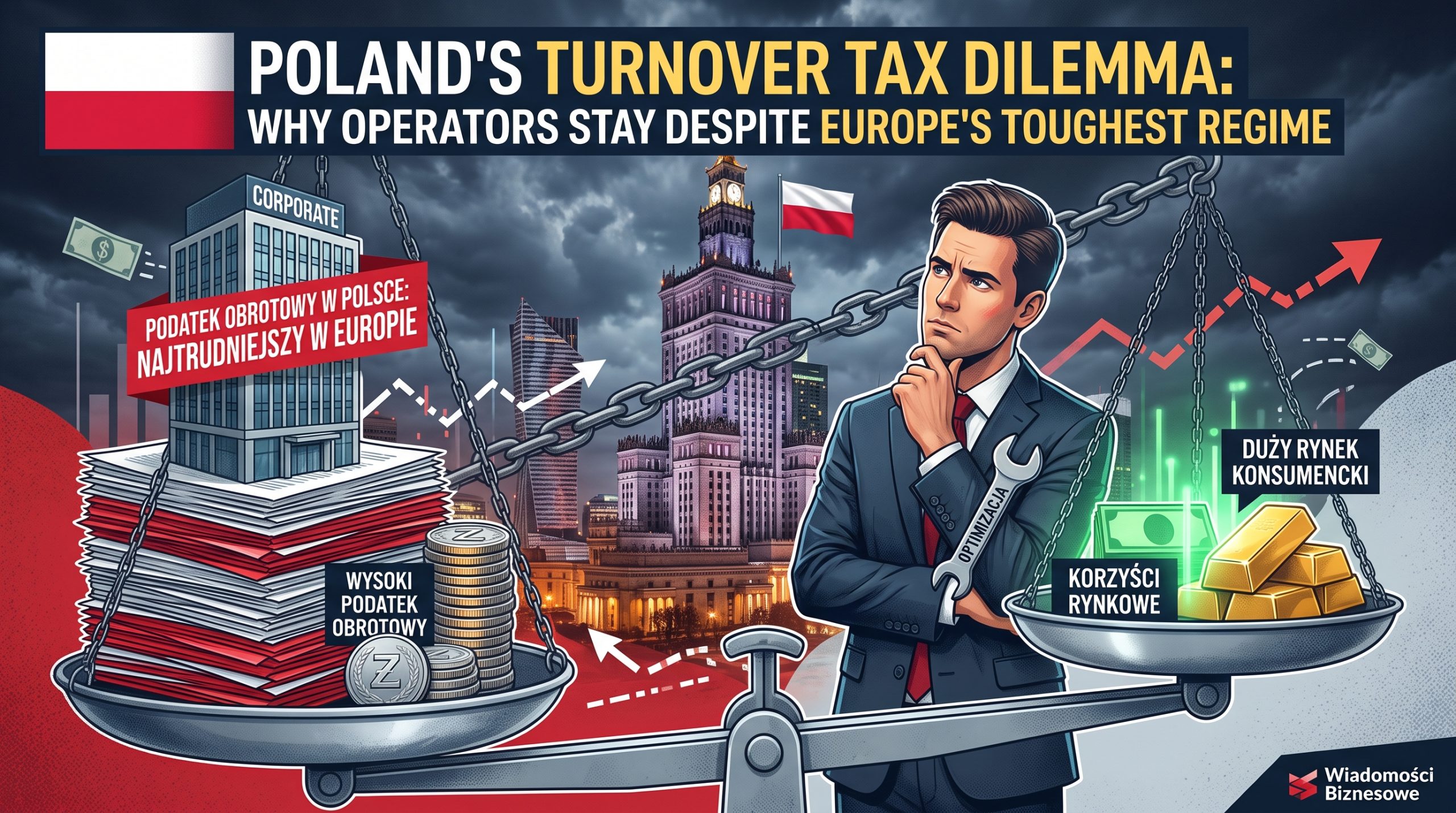
Poland has spent 17 years living with what many operators call the harshest gambling tax regime in Europe. The country levies a 12% turnover tax on private sports betting operators, a 50% GGR-based tax on casino, and a 10% winnings tax on players collected at source. And yet the market keeps growing, leaving licensed operators caught between painful short-term economics and long-term prospects too attractive to walk away from. This is the tension shaping one of Central Europe’s fastest-expanding gambling markets.
What the Polish Tax Debate Means for Operators
Before the numbers, the strategic picture. Poland is a market where the rules make life difficult but the demand curve refuses to cooperate with the pessimism.
- Turnover tax squeezes product competitiveness: The 12% levy on stakes forces operators to run high margins, weakening the offer against unregulated rivals.
- On a GGR basis, Poland arguably carries the second-highest sports betting tax in Europe after France.
- Growth despite the headwinds: Total market GGR is projected to reach $4.96 billion in 2026, following several years of double-digit growth, giving policymakers cover to resist reform.
- The online casino prize sits behind a monopoly: State-owned Totalizator Sportowy holds exclusivity, and private brands want in.
- Any shift to a GGR model would cut tax revenue sharply, which makes reform a hard sell politically.
How Poland Built Its Regime
Regulatory frameworks rarely emerge cleanly, and Poland’s is no exception. The country’s core gambling legislation passed in 2009, in the aftermath of a scandal that still colours public perception of the sector. So-called ‘Blackjack-gate’ saw senior figures in Prime Minister Donald Tusk’s government resign over leaked recordings pointing to corrupt dealings with industry lobbyists over tax hikes.
The 2009 Gambling Act set the tone: a 12% turnover tax on sports betting, a 50% GGR tax on casino, and a 10% winnings tax on players. Land-based casinos operate under licence. But since major reform in 2017, Totalizator Sportowy has held exclusivity over online casino and land-based slot machines outside of casinos. Online sports betting stayed open to private operators through licensing. The 2017 reforms also gave authorities powers to force payment providers to block services to a list of unlicensed gambling domains, though how well that enforcement works remains contested.
Overturn the Turnover Tax?
Two complaints dominate among licensed operators: the tax is high, and it distorts the product. “Turnover tax is aggressively anti-customer and always will be,” argues Myke Foster, group head of gaming at leading Polish sports betting brand Fortuna. “It prevents us offering as fun and as engaging a product as we’d like to. We want customers to feel the barrier to entry is as low as possible.”
Players see and feel the 10% tax on winnings. What they rarely register, Foster says, is how the turnover tax quietly narrows the options available to them. Because operators calculate tax on stakes before outcomes are known, they are pushed toward higher margins to absorb the uncertainty.
The data bears this out. H2 Gambling Capital figures show total sports betting GGR in Poland hitting €1.62 billion in 2026 on a projected gross turnover of €5.07 billion, implying a margin near 32%, well above averages elsewhere.
“The GGR margin is very high as the first 12% of turnover goes as tax, so there has to be a high margin to cover that,” explains Ed Birkin, managing director at H2 Gambling Capital. “Which makes the product less competitive against illegal operators and generally reduces demand.”
Hermann Miller, secretary general of the European Casino Association, calls managing the burden “almost impossible” without compromising the online experience. He draws a parallel: “It’s the same reason why in Germany no land-based casinos pick up an online gaming licence.” Germany’s turnover tax sits at 5%. Poland’s is more than double that.
Poland’s Market at a Glance
| Metric | Figure (2026 est.) |
|---|---|
| Total market GGR | €4.36 billion, of which €1.62 billion from sports betting |
| Sports betting turnover | €5.07 billion projected, implying a GGR margin of roughly 32% as operators price in the 12% turnover levy |
| Online sports betting channelisation | 78–88% |
| Online casino channelisation | ~59% |
| Totalizator Sportowy revenue (2025) | Reportedly $21 billion |
The Reform That Would Cost the Treasury
The case for switching to a GGR-based tax has been floated at home. In a 2021 opinion paper, economist and former finance minister Konrad Raczkowski argued Poland should replace the 12% turnover tax, which he estimates equates to 55–65% of GGR, with a GGR-based rate of 20–25% closer to the European average.
There’s a catch. A 20% GGR rate would slash tax revenue by nearly half based on 2026 turnover, assuming the market stayed still. “A shift from 12% turnover tax to 20% of GGR would indeed lead to a big fall in tax revenue,” Birkin notes. “This would be partially offset by market growth as operators would increase the payout or lower the GGR margin, and you’d get more recycling of funds, so turnover would go up substantially. But the overall tax take would decrease.”
Raczkowski counters that the shift would lift channelisation, pull operators into the legal sector, and drive long-term growth. Birkin lands on the same side, even accepting the lower take: “The optimal rate is going to lead to a reduction in tax generation, but tax should never be the primary motive of regulatory policy.”
Growth Comes Anyway, Black and White
Here is the awkward fact for reformers. The market grows despite the headwinds, which gives policymakers a ready argument that nothing needs fixing.
But could it grow faster, and cleaner? A 2024 Warsaw Enterprise Institute report estimated 83% of Polish players held accounts with unlicensed online casino operators. H2 places total online channelisation at 75.1%. And Poland’s unregulated sector doubled in size between 2017 and 2025, according to Zdzisław Kostrubała, VP of bookmaker STS, in remarks at the European Economic Congress last year.
That gap is the windfall the state has yet to capture. “There is a rising threat of grey and black-market bookmakers which are actively flouting rules and regulations to the detriment of the customer, to the detriment of the market, to the detriment of the tax dollars,” Foster says.
Liberalisation on the Horizon?
Even without touching the tax code, opening online casino would reshape the market’s economics. Totalizator Sportowy, though, runs deep in Polish life. Founded in 1955 to help rebuild sports infrastructure after the war, it now contributes $1.29 billion in annual revenues to the state.
Radosław Kietliński, a board advisor for the company, signalled at this year’s European Economic Congress that liberalisation is unlikely. “Whether we have a monopoly in Poland or not will not affect the black market at all,” he told the conference. “The best way to fight the unregulated market is to limit payments.” Public sentiment appears to back the monopoly: a 2025 study for the Adam Smith Research Centre found 50% of Poles supported keeping it, against 16% opposed (the study was commissioned by Totalizator Sportowy, according to local outlets).
The market disagrees. “Customers want online casino,” Foster says. “You’re not going to trick customers that these things don’t exist. They see them on TikTok and Instagram. Stopping brands like Fortuna, SuperBet, STS from operating casino products means you’re actually incentivising them to look elsewhere.”
It’s Politics, Stupid
The barriers to both reforms sit with politicians. Poland’s 2027 parliamentary elections could be the inflection point. Yet neither major party is seen as sympathetic. Law & Justice brought online casino under the monopoly. Civic Platform approved a rise in the player winnings tax from 10% to 15%, though President Karol Nawrocki vetoed it in 2025 before it took effect.
The clearest appetite for change lies with the hard-right Confederation party, ideologically opposed to state monopolies and high taxes. Marek Płota, managing partner at law firm RM Legal, told iGB in February that Confederation was the only party with liberalisation on its agenda. Absent a bigger share of the vote, he said, “meaningful legislative change is unlikely.”
Which leaves operators where they started: paying more than almost anyone else in Europe, waiting on a political calendar that has bigger items on it.
Frequently Asked Questions
What is Poland’s gambling tax rate?
Private sports betting operators pay a 12% turnover tax, casinos face a 50% GGR-based tax, and players pay a 10% tax on winnings collected at source.
Can private companies offer online casino in Poland?
No. Since the 2017 reforms, state-owned Totalizator Sportowy holds exclusive rights to online casino and to land-based slot machines outside casinos. Private operators are limited to licensed online sports betting.
Why do operators dislike the turnover tax specifically?
Because it taxes stakes before outcomes are known, it forces operators to run high margins, around 32% in Poland, to absorb the uncertainty. That makes the product less competitive and pushes some players toward unregulated sites.
How large is Poland’s unregulated market?
Estimates vary, but a 2024 Warsaw Enterprise Institute report put the share of Polish players with unlicensed online casino accounts at 83%, and the unregulated sector reportedly doubled between 2017 and 2025.
Is tax reform likely soon?
Not imminently. A move to a GGR model would cut state revenue significantly, and neither of the two main parties favours it. The Confederation party is the only one campaigning on liberalisation.