




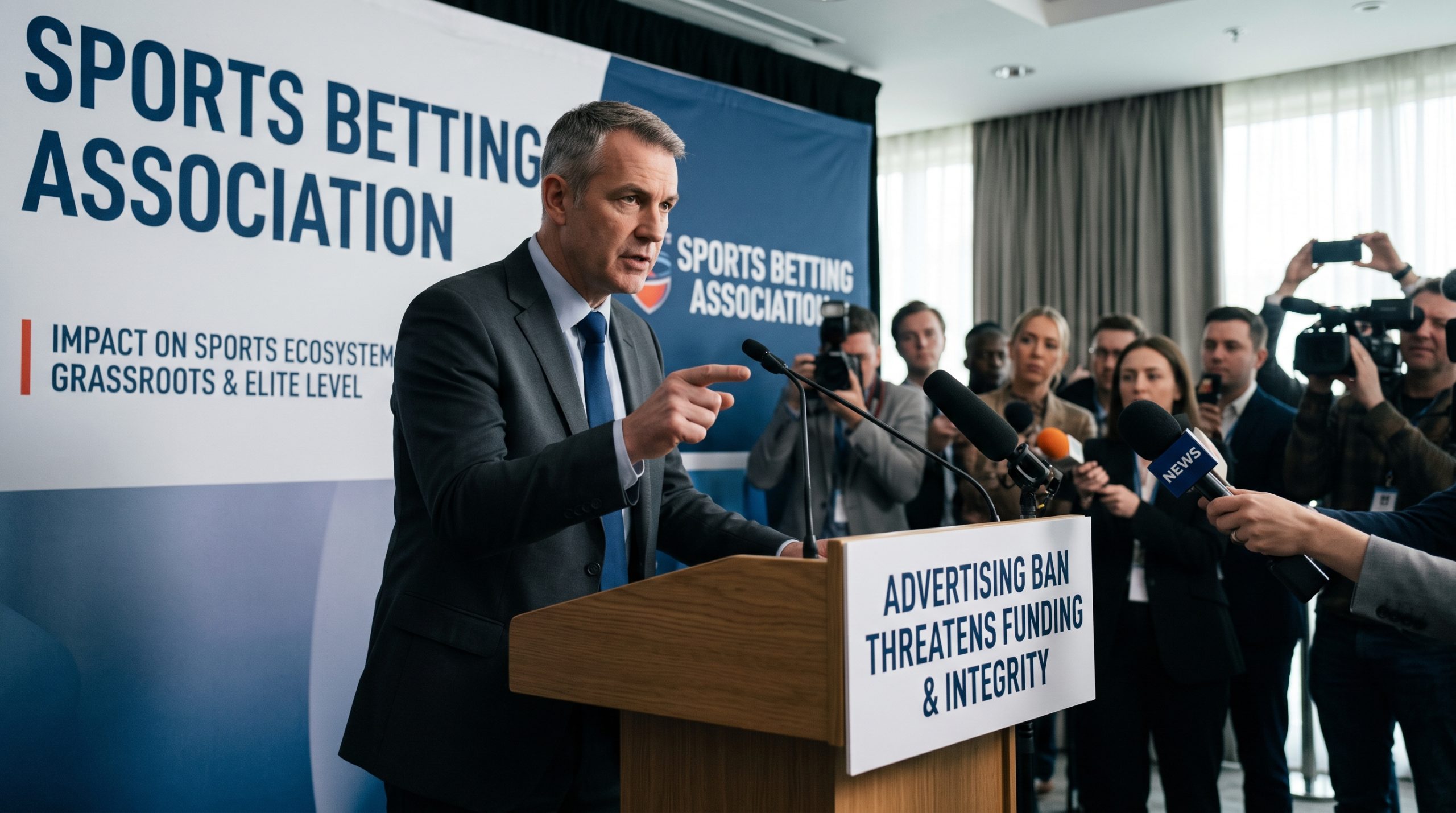
A leading betting and gaming trade association has pushed back against proposals for a sweeping advertising ban, warning that the measure would cut a significant revenue stream for sports bodies and weaken the financial relationships that underpin competition. The warning, issued in response to policymakers weighing tighter restrictions on gambling promotion, frames the consequences for sporting integrity as “particularly serious.” At stake is a web of sponsorship deals, broadcast arrangements, and funding channels that many clubs and governing bodies have come to depend on.
The debate lands at a moment when European regulators are revisiting how gambling brands reach consumers, particularly through sport. And the association’s intervention signals that the industry intends to fight the proposal on economic as well as ethical grounds.
What the Proposed Ban Means for Clubs and Sponsors
Before the specifics, the broad picture: a blanket advertising prohibition would not simply quieten the airwaves. It would sever contracts that fund player development, grassroots programmes, and in some cases the operating budgets of smaller clubs that lack the broadcast riches of top-tier competition.
- Revenue exposure: Sponsorship from betting operators represents one of the more reliable income lines for mid-tier and lower-division sports organisations, many of which have limited alternative commercial options.
- Integrity monitoring at risk: The association argues that regulated operators fund match-fixing detection and data-sharing arrangements that help flag suspicious betting patterns.
- Smaller clubs would feel the squeeze first.
- Market displacement: A ban on licensed operators, the association contends, does little to stop unregulated and unauthorised sites that ignore local advertising rules altogether.
That last point carries weight. Push licensed brands out of the shop window, and the audience does not vanish; it simply looks elsewhere (a distinction regulators have been slow to enforce).
The Integrity Argument, Unpacked
The association’s central claim is counterintuitive. It says restricting advertising could harm the very integrity that restrictions are meant to protect. Licensed operators, under their terms of authorisation, typically share betting data with sports governing bodies and integrity units. That data feeds the systems designed to catch irregular markets and suspicious wagering activity in near real time.
But cut the commercial tie, and the argument goes, you risk fraying the cooperation that comes with it. Whether that correlation holds in practice is harder to prove. What remains less clear is how much of the current integrity infrastructure is contractually bound to sponsorship versus mandated by regulation independently of it.
Still, the logic is not without foundation. Regulated firms operate inside a framework; unauthorised ones answer to no one.
Why the Timing Matters
Several jurisdictions have moved in recent years to curb gambling visibility, from shirt-front sponsorship limits to restrictions on broadcast advertising around live events. The precedent set by earlier measures gives regulators a template they have already signalled interest in extending. For an industry whose marketing spend flows heavily toward sport, each new restriction narrows the available channels.
The economic stakes are not abstract. Consider the structure of a typical dependency chain:
| Stakeholder | Primary exposure to an ad ban |
|---|---|
| Top-tier clubs | Loss of high-value shirt and stadium sponsorship, though broadcast income cushions the blow |
| Lower-division clubs | Direct threat to operating budgets with few replacement sponsors available in the near term |
| Governing bodies | Reduced funding for integrity units and grassroots investment |
| Licensed operators | Shrinking legal channels to reach audiences; competitive gap opens for offshore sites |
| Consumers | Less visible warning messaging and responsible-gambling signposting from regulated brands |
Where the Opposition Breaks Down
Not everyone sees it that way. Public health advocates and some lawmakers argue that the volume of gambling advertising normalises betting, particularly among younger and vulnerable audiences, and that voluntary codes have failed to contain exposure. They point to the sheer saturation of promotion around live sport as evidence that self-regulation has reached its limit.
The association, for its part, maintains that responsible messaging and safer-gambling tools are themselves delivered through regulated advertising channels. Guidance on player protection and the frameworks the industry references in its submissions draw on the standards promoted by bodies such as the resources available for safer gambling awareness, which operators cite as part of their consumer-protection case. Which raises a harder question: if advertising disappears, who delivers the warnings?
The Business Implications for Operators
For the betting sector, a ban reshapes the marketing calculus entirely. Customer acquisition costs rise when the most efficient channels close. Brand differentiation becomes harder in a market where visibility is capped. Operators would likely redirect spend toward affiliate marketing, retention, and digital channels that fall outside the ban’s scope, at least on paper.
The competitive asymmetry is the real concern. Licensed firms would carry the full weight of compliance while unauthorised operators, beyond the reach of domestic regulators, continue to advertise through grey channels. The result: a playing field tilted toward the least accountable actors.
Frequently Asked Questions
What exactly has the association proposed?
It has not proposed anything; it is responding to a potential advertising ban, warning that the measure would damage sports funding and integrity cooperation.
Why does it link advertising to sporting integrity?
Because licensed operators fund and feed integrity monitoring through data-sharing arrangements tied to their regulated status. The association argues that weakening commercial ties could erode that cooperation, though the strength of that link is debated.
Would a ban stop gambling advertising altogether?
Not according to the association. It argues unauthorised and offshore operators would keep advertising regardless, meaning a ban primarily constrains the licensed, accountable segment of the market.
Who is most exposed financially?
Lower-division clubs and smaller governing bodies, which rely on betting sponsorship and have fewer alternative revenue sources.
What Happens Next
The proposal remains under review, and the association’s submission is one voice among several competing pressures on policymakers. Public health groups will press their case; the industry will press back with the funding and integrity arguments laid out here. Between those positions sits a gap neither side has fully closed: how to protect vulnerable consumers without handing the market to operators who answer to no regulator at all.


