
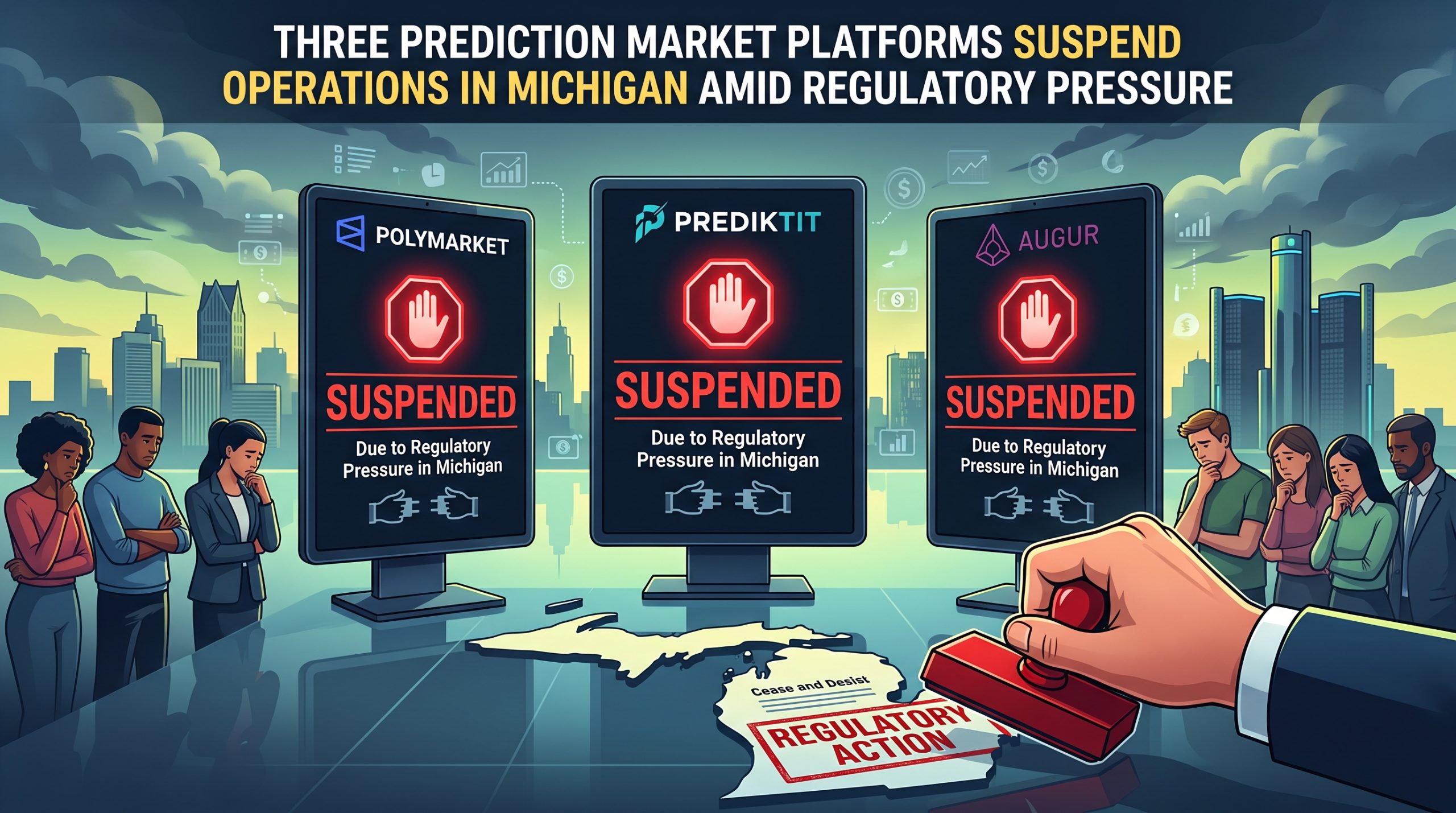
Three prediction market platforms, among them Kalshi and Robinhood, have halted operations in Michigan following action from state gaming regulators. The suspensions mark the latest front in a widening dispute over whether event-based contracts fall under gambling law or federal commodities oversight. For operators, the stakes are jurisdictional. For Michigan residents, the practical result is simpler: the markets went dark.
The move puts Michigan alongside a growing list of states challenging the legal footing of prediction markets, a sector that has expanded quickly on the back of political events, sports outcomes, and economic data.
What the Michigan Suspensions Mean for Operators
Before the specifics, the broader signal: regulators are no longer treating prediction markets as a novelty they can afford to ignore.
- Jurisdictional collision. The central fight is whether these platforms operate under Commodity Futures Trading Commission (CFTC) authority or state gambling rules. That distinction decides who gets to say no.
- Michigan has now joined other states applying pressure, raising the compliance cost of operating nationally without a settled federal answer.
- Revenue exposure. Each state withdrawal shrinks the addressable market for operators that built growth projections on nationwide access.
- Precedent risk. A pattern of state-level suspensions gives other regulators a template they can copy with minimal legal groundwork.
- Robinhood’s involvement pulls a mainstream brokerage, not just a niche exchange, into the regulatory crosshairs.
A Dispute Over Who Holds Authority
Prediction markets let users trade contracts tied to the outcome of real-world events. Pay a price now, collect a fixed payout if your side is right. The mechanics look like trading. To many state regulators, they look a lot like betting.
That tension sits at the heart of the Michigan action. Platforms such as Kalshi have argued that their contracts are regulated financial instruments overseen at the federal level, placing them outside the reach of individual state gaming divisions. State authorities counter that offering wagers on sporting and other events, without a state licence, falls squarely within their enforcement remit. The companies behind the event-contract trading platforms now suspended in the state have framed the matter as one of federal preemption, a position that courts have yet to resolve uniformly.
And while the legal theory is contested, the operational reality is not. When a state issues a directive, continued activity invites penalties most operators would rather avoid than litigate from a position of exposure.
Why the Timing Matters Now
Prediction markets drew heavy attention during recent US election cycles, when political contracts generated record volumes and mainstream media coverage. That visibility cut both ways. It validated the sector commercially and put it on the radar of regulators who had previously paid it little mind.
Michigan’s gaming oversight apparatus, which licenses commercial and tribal casinos as well as online sports betting, has a direct interest in how unlicensed event contracts interact with its regulated market. The concern, at least on paper, is consumer protection and the integrity of a licensing regime the state spent years building.
Which raises a harder question: if contracts on sports outcomes are financial instruments, what stops any licensed gambling product from rebranding itself the same way?
Comparing the Regulatory Positions
| Stakeholder | Core Position | Primary Interest |
|---|---|---|
| Prediction platforms | Contracts are CFTC-regulated financial instruments exempt from state gambling law | Maintaining uninterrupted nationwide access and defending the federal-preemption argument |
| Michigan regulators | Unlicensed event wagering falls under state gaming authority | Protecting consumers and the integrity of the state’s licensed betting and casino framework |
| Operators affected | Compliance now, litigate later if needed | Avoiding penalties while the legal picture remains unsettled across multiple states |
The Business Implications of a Fragmented Map
For a sector that scaled on the promise of frictionless, borderless access, state-by-state suspensions impose exactly the friction the model was built to avoid. Every withdrawn jurisdiction forces geofencing, compliance review, and a recalculation of user reach. None of that is free.
Robinhood’s position is worth isolating. As a publicly listed brokerage with millions of accounts, it carries reputational weight that a standalone exchange does not. Regulatory entanglement in one product line can draw scrutiny toward the whole business, which is a different calculus from that of a pure-play prediction venue.
The precedent cuts deepest here. If Michigan’s approach holds and spreads, operators face a patchwork rather than a market. Some states open, some closed, each with its own interpretation of the same federal statute. In practice, that fragmentation can erode the economics of the model faster than any single enforcement action.
What Happens Next
The decisive battleground is the courts and, potentially, clarifying action from federal regulators on how far CFTC oversight extends into event contracts that resemble gambling. Until that question resolves, operators are likely to keep choosing suspension over confrontation in states that push back.
The companies have not detailed a timeline for returning to Michigan. What remains less clear is whether a resolution in one jurisdiction would settle the matter nationally or simply shift the fight to the next state with a gaming division and a reason to use it.
Frequently Asked Questions
Which platforms suspended operations in Michigan?
Three prediction market platforms, including Kalshi and Robinhood, have suspended operations in the state following regulatory pressure.
Why did Michigan target prediction markets?
State regulators view unlicensed event-based wagering as falling under their gaming authority. The platforms argue their contracts are federally regulated financial instruments, not gambling, and the two positions have yet to be reconciled in court.
Are prediction markets legal in the United States?
Their status is contested. The platforms operate under claimed CFTC oversight, but several states dispute that they can offer event contracts without a state licence.
Could this spread to other states?
It already is. Michigan joins a growing group of states challenging these platforms, and each action makes the next one easier to justify.
Will the platforms return to Michigan?
No return timeline has been confirmed. Any comeback likely depends on how the broader legal question over federal versus state authority is settled.