



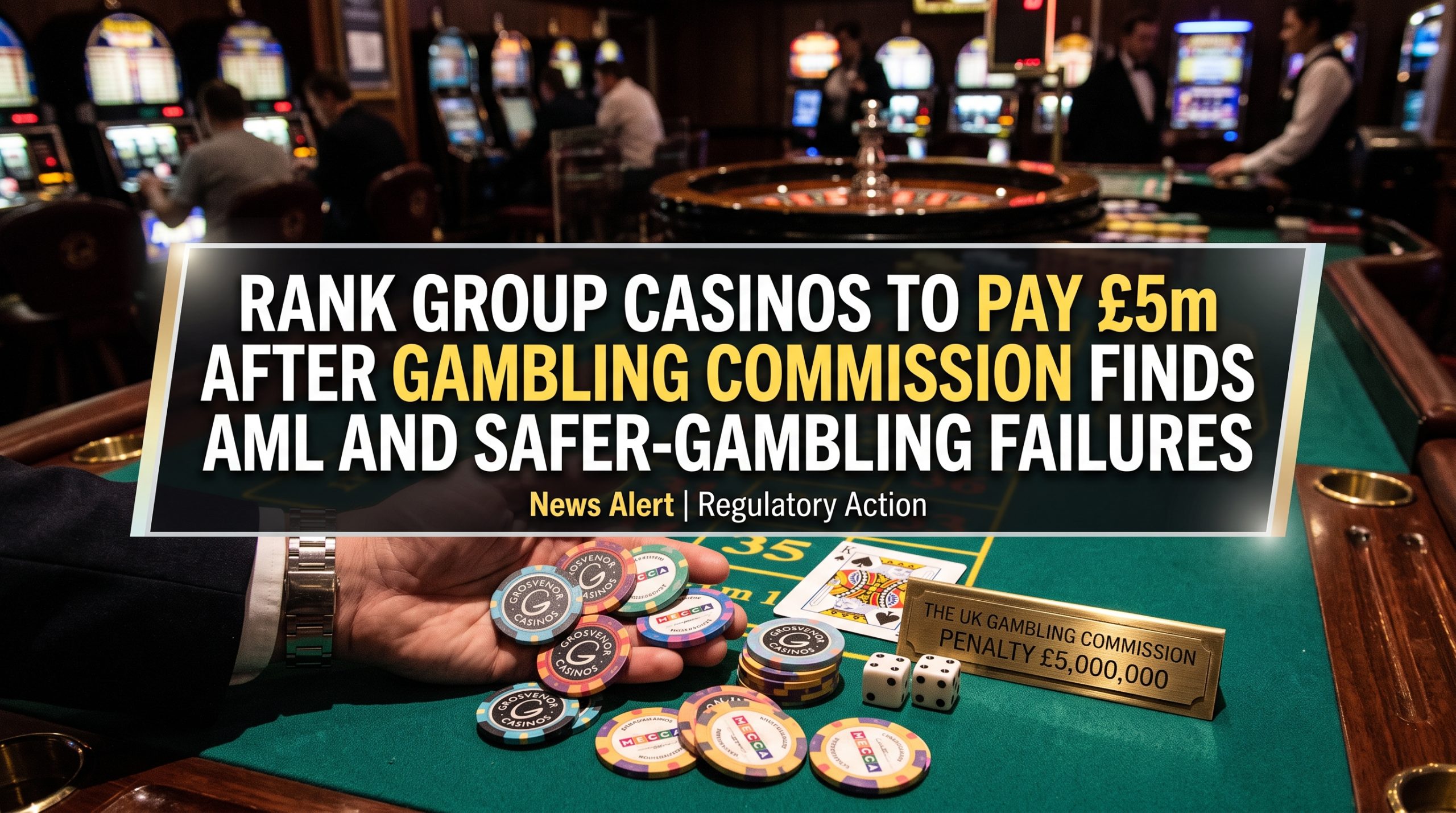
Three land-based casino operators owned by Rank Group PLC have agreed to pay more than £5 million ($6.6 million) after the UK Gambling Commission uncovered systemic failings in anti-money laundering (AML) and safer-gambling controls. The settlement, confirmed on Wednesday, covers Grosvenor Casinos Limited, Grosvenor Casinos (GC) Limited and Gaming Group Limited, which between them run 51 casinos across Great Britain. The companies will pay £5,012,261 into the government’s consolidated fund and have agreed to a third-party audit of their compliance arrangements.
The case lands a familiar warning on an unfamiliar target. Big enforcement has long been the online sector’s problem. Not this time.
What the Settlement Means for Operators on the High Street
The Rank case reframes where regulatory risk actually sits. For years, the heaviest penalties fell on online platforms, where customer volumes and transaction speed made failures easy to scale. This settlement signals that physical venues carry the same exposure, and that the Commission intends to treat them that way.
- Financial exposure is real for land-based estates: A £5m settlement for a 51-casino footprint sets a concrete benchmark for retail operators weighing the cost of weak controls.
- Third-party audits are becoming the price of resolution. Rank’s agreement to independent assessment points to a stricter, verify-don’t-trust posture from the regulator.
- Cryptocurrency provenance is now an explicit compliance gap, with staff accepting crypto-derived funds once converted to sterling but without tracing their origin.
- Discretionary decisions by venue managers, left without firm guidance, are being treated as a structural weakness rather than isolated human error.
- Safer-gambling intervention must be demonstrable: repeated low-level nudges with no effectiveness check no longer satisfy the regulator.
A Licence Review Triggered by Intelligence
The Commission opened a licence review under Section 116 of the Gambling Act 2005 after receiving reports and intelligence about the three operators. A targeted compliance assessment followed in June 2025. The published report described weaknesses that were not confined to one venue or one process but ran across both AML and social responsibility functions.
At the centre of the AML findings was a basic lapse: the operators had not updated their policies to reflect changes introduced to the UK Money Laundering Regulations in 2020. Because of that, some customers who should have been flagged as higher-risk were not. And where enhanced due diligence was mandated by the companies’ own rules, it was sometimes skipped entirely. The report singled out students from high-risk jurisdictions and customers with unusual funding patterns as cases where checks fell short.
The Human Cost Behind the Safer-Gambling Breaches
The safer-gambling findings are harder to read as paperwork problems. The regulator cited a customer who lost roughly £50,000 with no recorded intervention. Another, a long-standing patron, won around £260,000 and then lost £250,000 inside twelve days, with nothing on record to show anyone stepped in. A returning customer dropped £25,000 before a single protective interaction was logged.
What the Commission described was a pattern of inaction dressed up as engagement: repeated low-level interventions, no assessment of whether they worked, and delayed escalation to harder measures like deposit limits or debit-card restrictions. These breaches hit specific conditions of the Licence Conditions and Codes of Practice (LCCP), chiefly the duty to prevent gambling from being used to facilitate crime. Twelve days. A quarter of a million pounds. No recorded conversation.
Numbers Behind the Case
| Detail | Figure |
|---|---|
| Total settlement | £5,012,261 (£5m+) |
| Casinos operated by the three entities | 51 across Great Britain |
| Compliance assessment conducted | June 2025 |
| Cited loss without intervention | Approx. £50,000 |
| Long-standing customer loss window | £250,000 lost in 12 days, after winning around £260,000 |
| Regulatory basis | Section 116 licence review, Gambling Act 2005; LCCP breaches |
Rank’s Response and the Regulator’s Message
Rank’s Grosvenor Casinos land-based venues confirmed acceptance of the findings and the settlement. The group said it had moved quickly to put corrective measures in place and cooperated fully throughout the investigation, both of which the Commission counted as mitigation when setting the final figure.
Sue Young, executive director of operations at the Gambling Commission, used the announcement to draw a line under the assumption that enforcement is an online story. “Larger enforcement cases are often associated with online gambling but, as today’s announcement shows, the risks of anti-money laundering and social responsibility failures are equally alive in the land-based sector,” she said. She urged other retail operators to review their own arrangements with the same scrutiny.
The timing is not incidental. The Commission’s 2026 AML risk assessment flagged operator-side failings as a recurring theme across subsectors, naming weak AML and counter-terrorist-financing policies and poorly trained staff among the most common deficiencies. In plain terms: the regulator already knew what it was looking for before it walked in.
How the Settlement Was Foreseen
Rank had telegraphed the outcome. Grosvenor Casinos Limited’s licence had been under review for compliance issues spanning 2024 and 2025, and on its 2025 full-year earnings call the company disclosed a planned £5 million provision tied to a proposed regulatory settlement. The final number landed almost exactly where it said it would, which suggests the negotiation was less about size than about process.
Yet the audit requirement may prove the more consequential term. A cheque clears once. An independent review of whether AML and social responsibility policies are actually working keeps the operator accountable well past the headline figure, and gives the regulator a template it can apply to the next retail operator that comes under scrutiny.
Frequently Asked Questions
How much is Rank Group paying and where does the money go?
The three entities will pay £5,012,261 into the UK government’s consolidated fund, rather than a conventional fine, as part of a regulatory settlement.
Which companies and venues are affected?
Grosvenor Casinos Limited, Grosvenor Casinos (GC) Limited and Gaming Group Limited, all owned by Rank Group, which together operate 51 casinos across Great Britain.
What were the main failings identified?
Outdated AML policies that ignored 2020 regulatory changes, inconsistent enhanced due diligence, unclear handling of cryptocurrency as a source of funds, and a string of safer-gambling cases where heavy losses drew no recorded intervention.
Does this only matter for online gambling firms?
No. That is the point of the case. The Commission explicitly stated that land-based operators face the same AML and social responsibility obligations, and it is inviting the retail sector to audit itself before the regulator does.
What happens next for Rank?
Beyond the payment, Rank has agreed to a third-party audit assessing whether its AML and social responsibility policies are being implemented effectively, keeping the operator under external review.


