





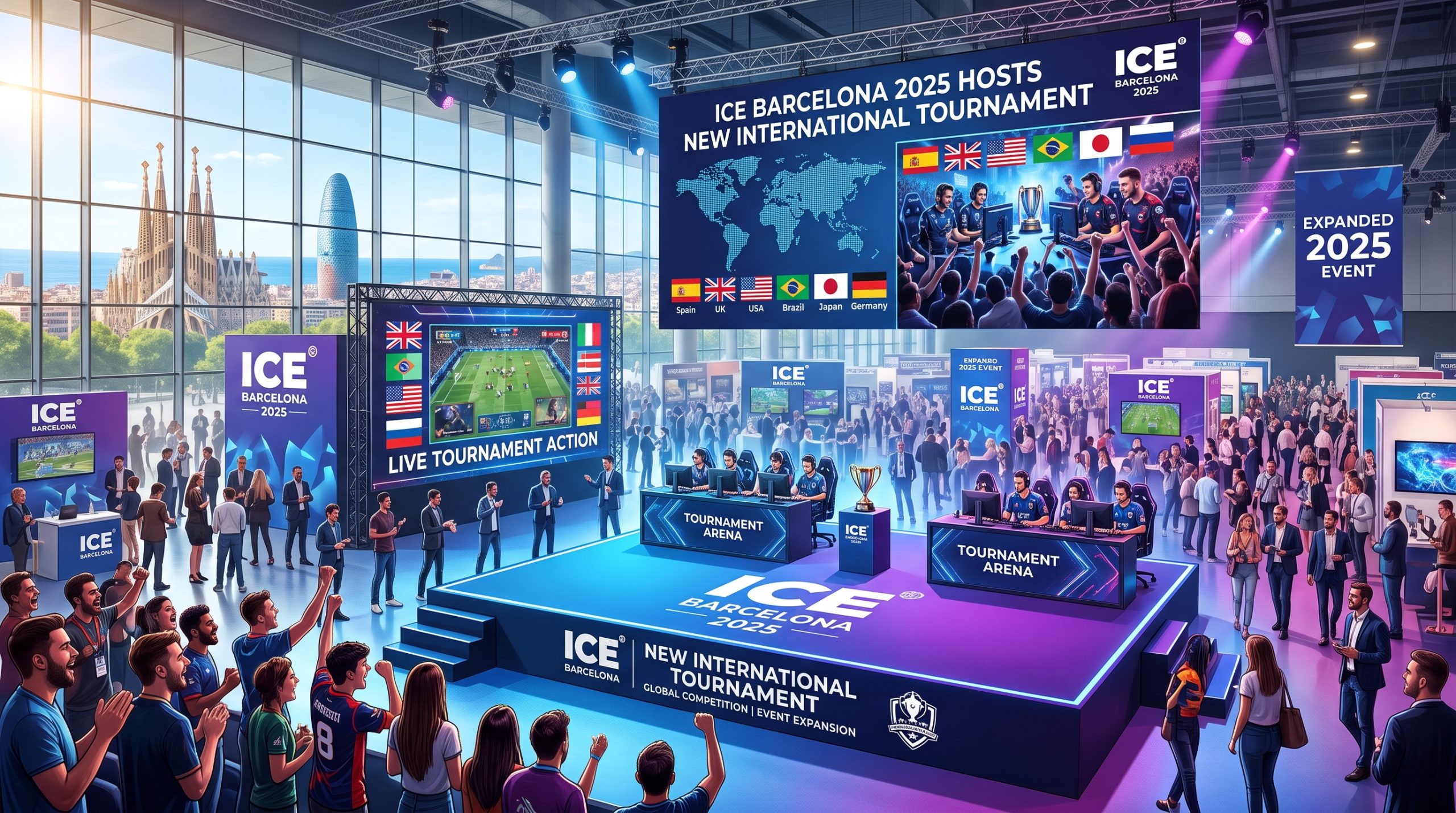
Organisers behind ICE Barcelona have confirmed plans for a new tournament designed to run alongside the exhibition, with the stated ambition of turning it into a recurring fixture on the international gaming calendar. The announcement positions the competition as a structural addition to one of the sector’s largest annual gatherings, held in the Catalan capital. For operators, suppliers, and affiliates already planning their presence, the move adds a competitive layer to an event better known for deal-making than contests.
What the New Tournament Means for ICE Barcelona Attendees
The context matters before the details do. ICE relocated its flagship show to Barcelona after years in London, and the event has been rebuilding its identity in a new market ever since. A tournament attached to that calendar slot gives organisers a fresh reason for repeat attendance, and gives exhibitors a programmed moment of visibility that a trade floor alone rarely delivers.
- Recurring format: The tournament is intended to return each year, not function as a one-off, which changes how brands budget and plan their activation around the show.
- Co-location with ICE Barcelona means built-in footfall, removing the hardest problem any new event faces: getting the right people in the room.
- Audience overlap: Executives, regulators, and industry professionals already attending gain a second reason to stay on-site, extending dwell time and commercial exposure.
- A regular fixture, in practice, compounds its own value: each edition builds on the reputation of the last.
A Trade Show Adapting to a Competitive Market
Exhibitions across the gaming industry have faced the same pressure for years. Attendance is expensive, calendars are crowded, and digital alternatives keep eating into the case for showing up in person. Adding a tournament is one answer to that pressure.
It also reflects a broader shift in how large B2B events justify their footprint. The trade floor sells access; the surrounding programme sells experience. By anchoring a competition to the ICE Barcelona gaming exhibition, organisers are betting that engagement, not just square metres of booth space, keeps the event relevant. Whether that bet pays off depends on turnout, and turnout depends on who actually competes.
And that is the question the announcement leaves open.
Why the Timing Works in Barcelona’s Favour
Barcelona has become a serious contender in the European events economy. The city hosts major technology and mobile gatherings, has the hotel capacity to absorb tens of thousands of delegates, and sits inside a Spanish market with established, licensed gaming operations. For an event still consolidating its post-London position, those fundamentals reduce the risk of launching something new.
The tournament arrives while the host city is still proving its value as ICE’s home. That sequencing is deliberate. A high-visibility format gives the event a talking point beyond the venue change, and a reason for coverage that is not simply logistical.
Strategic Impact for Brands and Operators
For commercial teams, a co-located tournament reshapes the calculation of attendance. Sponsorship inventory expands. There are naming opportunities, participation slots, and content moments that did not exist before. But new inventory only converts to value if the audience is the one brands want to reach.
| Stakeholder | Potential Benefit |
|---|---|
| Exhibitors | Additional sponsorship and activation inventory tied to a scheduled, high-attention event rather than passive booth traffic |
| Operators | Extended face time with suppliers and peers across a longer on-site programme |
| Organisers | A differentiator that strengthens the case for annual return and supports Barcelona’s long-term claim on the event |
| Attendees | A reason to extend their stay |
Reading the Move Against Industry Trends
The decision fits a pattern visible across large-scale B2B gatherings: the pivot from pure exhibition toward curated experience. Conferences add awards. Expos add live demonstrations. Trade shows add competitions. Each of these moves chases the same goal, which is to make the physical event irreplaceable in a calendar where almost everything else can happen on a screen.
What separates this from a marketing gesture is the stated intent to make it permanent. A single tournament is an experiment. A fixture is a commitment, and commitments reshape how partners and participants plan their year. The organisers have signalled the latter, at least on paper.
Still, ambition and recurrence are not the same thing. Plenty of events have promised annual returns and quietly disappeared after one edition. The ones that last build genuine demand into the format from the start. Whether this tournament does that will be measurable, eventually, in a single figure: how many come back.
Frequently Asked Questions
What is the new ICE Barcelona tournament?
It is a competition set to run alongside the ICE Barcelona exhibition, with organisers stating they intend it to become a regular fixture on the international calendar rather than a single event.
When and where will it take place?
The tournament is scheduled to take place in conjunction with ICE Barcelona, held in Barcelona, Spain, as part of the broader event programme.
Why is this significant for the gaming industry?
It reflects how major trade shows are adding experiential formats to sustain in-person attendance. For brands, it creates new sponsorship and engagement opportunities tied to a scheduled, high-attention moment.
Will the tournament return every year?
Organisers have described it as a recurring fixture. Long-term continuity, in practice, will depend on participation and commercial support across its first editions.
What Industry Professionals Should Watch Next
The immediate signals to monitor are straightforward: participation numbers, the calibre of entrants, and whether sponsors treat the format as core inventory or an afterthought. Those metrics will reveal more than any launch statement about the tournament’s real traction.
Barcelona’s bid to hold onto ICE gains another supporting argument with this addition. The tournament gives the city and the event a shared story to tell, one that goes beyond venue size and transport links. For an industry that measures everything, the first edition will supply the only number that matters.


